
Wilson’s Disease Treatment in Delhi NCR
- Wilson’s disease is a rare inherited disorder that causes copper to build up in the liver, brain, eyes and other organs.
- Treatment may include copper-chelating medicines, zinc therapy and dietary changes. Liver transplantation may be considered in severe liver disease, acute liver failure, and selected patients with severe neurological disease.
- Dr. Ankur Garg at Paras Hospital, Gurugram, provides evaluation and treatment for Wilson’s disease, including assessment for liver transplantation when required.
What Is Wilson’s Disease?
Wilson’s disease is an inherited disorder of copper metabolism. It can affect children, teenagers and adults and may present with liver, neurological, psychiatric or other symptoms.
Wilson’s disease occurs when the body cannot properly remove excess copper.
The condition is caused by mutations in the ATP7B gene. This affects the liver’s ability to transport and excrete copper into bile. As copper accumulates, it can damage the liver and, in some patients, the brain and other organs.
Wilson’s disease is an autosomal recessive disorder. A person generally needs to inherit a disease-causing variant from both parents to develop the condition. Parents who carry one disease-causing variant usually do not have the disease themselves. If both parents are carriers, each pregnancy has a 25% chance of producing a child affected by Wilson’s disease.
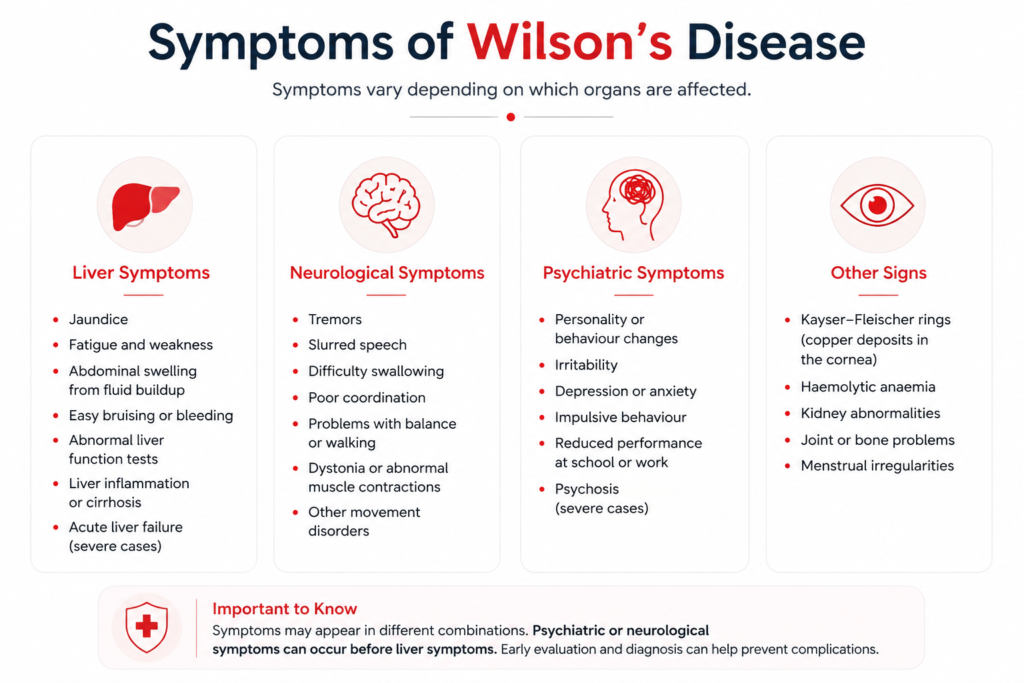
Wilson’s Disease Symptoms
Wilson’s disease can affect the liver, brain and other organs, so symptoms can vary from person to person. Liver, neurological and psychiatric symptoms may occur at different stages of the disease.
Reach Out for Expert Care
How Is Wilson’s Disease Diagnosed in Delhi NCR?
Diagnosis of Wilson’s disease is based on a combination of symptoms, examination findings, biochemical tests and, when appropriate, genetic or liver-based testing. The Leipzig score is commonly used to combine diagnostic findings. Current European guidance also recognises relative exchangeable copper as an additional diagnostic measure in appropriate settings.
Blood and Urine Tests
Common tests include:
- Serum ceruloplasmin
- 24-hour urinary copper
- Liver function tests
- Other blood tests based on the clinical presentation
Ceruloplasmin is often low and urinary copper may be elevated in Wilson’s disease, but results must be interpreted along with the patient’s symptoms and other findings.
Slit-Lamp Eye Examination
An ophthalmologist can use a slit-lamp examination to look for Kayser-Fleischer rings.
The rings support the diagnosis but their absence does not rule out Wilson’s disease, particularly when the disease mainly affects the liver.
Liver Copper Measurement and Liver Biopsy
In selected patients, a liver biopsy may be used to measure hepatic copper and assess liver damage.
Liver biopsy is not required in every patient. It may be considered when the diagnosis remains uncertain or when information about liver involvement is needed.
Genetic Testing
Genetic testing can identify disease-causing variants in the ATP7B gene. It can be useful when the diagnosis is uncertain and for testing family members after a diagnosis has been established.
First-degree relatives of a person diagnosed with Wilson’s disease should be evaluated because early detection can allow treatment before significant symptoms develop.
How Is Wilson’s Disease Treated?
Wilson’s disease requires long-term treatment to reduce copper accumulation and prevent further organ damage.
Treatment is selected based on the patient’s symptoms, liver involvement, neurological status, copper levels, and response to therapy.
-
Copper Chelation Therapy
Chelating medicines bind copper and increase its removal from the body.
Common chelators include:
| Medicine | Role |
| D-penicillamine | Chelates copper and increases its urinary excretion |
| Trientine | Chelates copper and is an alternative to D-penicillamine |
-
Zinc Therapy
Zinc reduces the absorption of copper from the intestine.
It may be used in selected patients, including some people with asymptomatic or pre-symptomatic disease and as maintenance treatment after initial copper control.
The choice between zinc and a chelating agent depends on the patient’s clinical situation. Regular monitoring is important to ensure that treatment is effective and does not result in copper deficiency.
-
Dietary Changes
Dietary changes support medical treatment but cannot replace medication.
People with Wilson’s disease may be advised to reduce their intake of foods high in copper, especially during the initial phase of treatment.
Foods commonly restricted include:
- Shellfish, particularly oysters
- Liver and other organ meats
- Nuts
- Chocolate and cocoa
- Mushrooms
Patients may also be advised to avoid copper cookware and containers and, where relevant, to check drinking water for excess copper. Dietary advice should be individualised by the treating team.
When Is Liver Transplantation Needed?
Most people with Wilson’s disease can be managed with medical treatment. Liver transplantation is considered when medical treatment is not sufficient or when severe liver disease develops.
Possible indications include:
- Acute liver failure caused by Wilson’s disease
- Decompensated cirrhosis that does not respond adequately to medical treatment
- Selected patients with severe neurological Wilson’s disease, following specialist assessment
Acute liver failure due to Wilson’s disease requires urgent evaluation at a liver transplant centre. Current EASL guidance also recognises a role for transplantation in selected patients with severe neurological involvement.
Liver transplantation replaces the affected liver with a donor liver that has normal copper-handling function. It can correct the underlying hepatic copper-excretion defect. The extent to which neurological symptoms improve after transplantation varies between patients.
The liver transplant programme at Paras Hospital, Gurugram, provides transplant evaluation for patients who may require this treatment.
Wilson’s Disease in Children
Wilson’s disease can present during childhood or adolescence, often with liver-related symptoms.
Possible signs include:
- Unexplained jaundice
- Abnormal liver enzymes
- Liver inflammation
- Cirrhosis
- Acute liver failure
Neurological or behavioural symptoms may develop later. Since Wilson’s disease is inherited, family screening is important after a diagnosis. Siblings and other first-degree relatives may require evaluation even if they have no symptoms.
Reach Out for Expert Care
Why Choose Dr. Ankur Garg for Wilson’s Disease Treatment Delhi NCR?
Book a Consultation for Wilson’s Disease Treatment in Delhi NCR
Get Liver specialist evaluation for Wilson’s disease, including review of existing reports, treatment planning, second opinions and liver transplant assessment when required.
A consultation may be appropriate if you have:
- A confirmed diagnosis of Wilson’s disease
- Abnormal liver tests with no clear cause
- Symptoms suggestive of Wilson’s disease
- A family member diagnosed with Wilson’s disease
- Questions about ongoing treatment or a second opinion
- Advanced liver disease requiring transplant evaluation
Book appointment to consult Dr. Ankur Garg

Dr. Ankur Garg's Medical Content Team
Dr. Ankur Garg’s medical content team specialises in creating accurate, clear, and patient-focused healthcare content. With strong clinical understanding and expertise in technical writing and SEO, the team translates complex medical information into reliable, accessible resources that support informed decisions and uphold Dr. Ankur Garg’s commitment to quality care.

 WhatsApp