
Acute Liver Failure Treatment in Gurgaon
Acute liver failure (ALF) is a rare but life-threatening condition in which the liver loses its functional capacity rapidly, often within days to weeks, in a person with no prior history of liver disease. It is one of the most complex medical emergencies in hepatology, requiring immediate hospitalisation, intensive monitoring, and specialist-led decision-making.
For patients and families seeking emergency liver failure treatment in Gurgaon, Dr. Ankur Garg at Paras Health, Gurugram, provides acute liver failure management, from ICU-based stabilisation to urgent liver transplant evaluation when required.
With over 25 years of experience in liver transplantation and HPB surgery, and more than 4,500 liver transplants performed, Dr. Ankur Garg’s team is experienced in managing both the medical complexities and surgical demands of acute liver failure in Gurgaon and Delhi NCR.
What is Acute Liver Failure?
Acute liver failure is defined as the rapid loss of liver function, typically over less than 26 weeks, resulting in coagulopathy (impaired clotting) and hepatic encephalopathy in a patient without pre-existing liver disease.
This distinguishes it from liver cirrhosis and end-stage liver disease, where damage occurs over months or years.
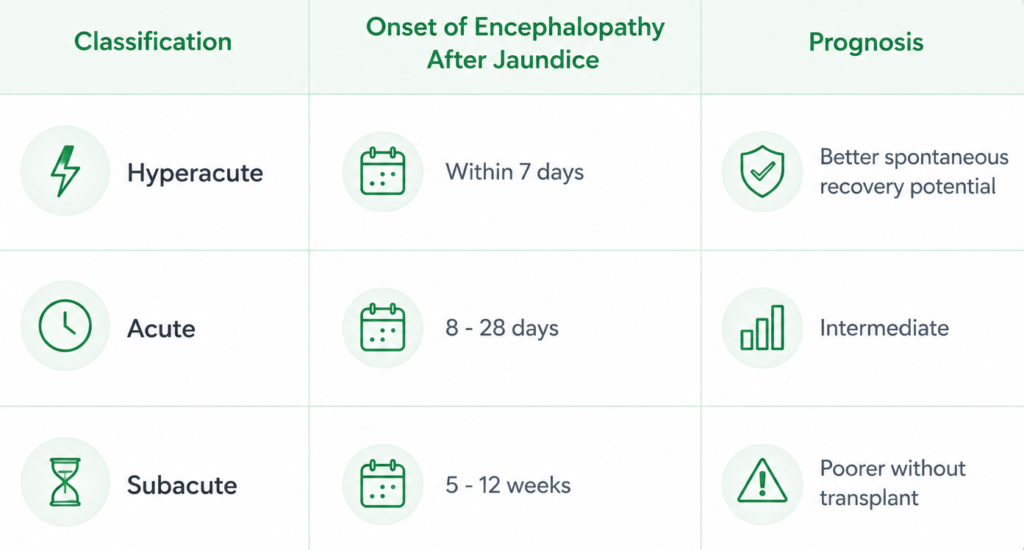
Acute liver failure is further classified based on the interval between the onset of jaundice and encephalopathy:
Symptoms of Acute Liver Failure
In acute liver failure, early symptoms are often non-specific, like fatigue, nausea, and mild jaundice, and may be dismissed as a viral illness. The clinical picture changes rapidly, and families should seek immediate evaluation if the following signs appear:
Early Warning Signs:
- Progressive jaundice
- Extreme fatigue and inability to perform daily activities
- Nausea, vomiting, and loss of appetite
- Right upper abdominal discomfort or tenderness
Signs of Deterioration – Seek Emergency Care Immediately:
- Confusion, disorientation, or unusual behaviour (early hepatic encephalopathy)
- sudden drowsiness
- Easy bruising or bleeding gums (coagulopathy)
- Dark urine and pale stools
- Rapid abdominal distension
Late-Stage Signs:
- Unresponsiveness (Grade III–IV encephalopathy)
- Seizures
- Signs of renal failure – reduced urine output, swelling of the legs
- Internal bleeding – vomiting blood or passing black tarry stools
If any of these symptoms are present in a patient with jaundice, do not wait. Contact liver failure specialist in Gurgaon immediately or proceed to the emergency department at Paras Health, Gurugram.
Reach Out for Expert Care
Causes and Risk Factors of Acute Liver Failure
Identifying the underlying cause of acute liver failure is essential, as some conditions (e.g., paracetamol toxicity or acute viral hepatitis) may be reversible with treatment, while others require early transplant.
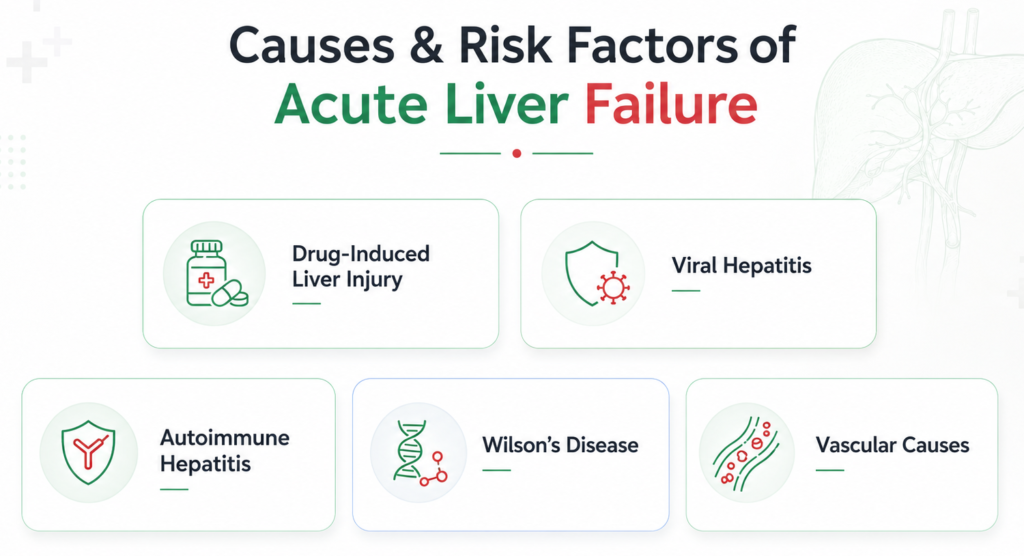
Early recognition of the underlying cause is critical in acute liver failure, as it directly influences management decisions, prognosis, and the urgency for liver transplantation.
Diagnosis of Acute Liver Failure in Gurgaon
The diagnostic workup under Dr. Ankur Garg’s team is planned to identify the cause, grade the severity, and assess for transplant candidacy, all within the first hours of case presentation.
Blood Tests
- Liver Function Tests (LFTs)
- Coagulation Profile
- Complete Blood Count (CBC)
- Kidney Function Tests
- Ammonia Levels
- Arterial Blood Gas (ABG)
Specific Tests
- Viral serologies
- ANA, ASMA, anti-LKM1, serum IgG
- Serum ceruloplasmin and 24-hour urinary copper (for Wilson’s disease)
- Drug history, including herbal and Ayurvedic medications
- Toxicology screen
Imaging
- Ultrasound Abdomen with Doppler
- CT Scan Abdomen
- MRI/MRCP
Grading of Encephalopathy
Hepatic encephalopathy is graded using the West Haven Criteria from Grade I (mild confusion) to Grade IV (coma). Grading determines the urgency of ICU admission and transplant listing.
Acute Liver Failure Treatment in Gurgaon
Acute liver failure treatment is a time-sensitive, multidisciplinary intervention that prevents life-threatening complications and determines whether a liver transplant is required.
All patients with acute liver failure require admission to a high-dependency or intensive care unit. At Paras Health, Gurugram, patients receive:
- Continuous monitoring of vitals, liver function, INR, ammonia, blood glucose, and renal parameters
- Strict fluid balance management
- Nutritional support, adequate calorie and protein delivery
- Prevention of hypoglycemia with continuous glucose infusion
- Prophylactic measures against infection
When Is a Liver Transplant Required in Acute Liver Failure?
For patients who do not respond to medical management, liver transplantation remains the only curative option and can be lifesaving when performed in time. The decision to list a patient for transplant is a time-sensitive judgment.
Types of Liver Transplant for ALF at LivCure:
- Living Donor Liver Transplant (LDLT):
As deceased donor organs may not be available in time, a living donor transplant is often the only viable option in ALF. A healthy close relative undergoes evaluation and, if eligible, donates the right lobe of their liver. Both donor and recipient benefit from the liver’s regenerative capacity.
- ABO-Incompatible Liver Transplant:
In life-threatening ALF where no blood-group-compatible donor is available within the critical window, Dr. Ankur Garg performs ABO-incompatible liver transplants.
Reach Out for Expert Care
When to Seek Emergency Care in Acute Liver Failure
Rush to the emergency department immediately if the patient develops:
- Confusion or excessive drowsiness
- Severe jaundice
- Bleeding gums or vomiting blood
- Seizures or loss of consciousness
- Rapid abdominal swelling
- Reduced urine output or breathing difficulty
Acute liver failure can worsen within hours. Early ICU care and timely liver transplant evaluation can be lifesaving.
Acute Liver Failure Survival Rate
Outcomes in acute liver failure have improved dramatically over the past two decades, driven by better ICU care, earlier transplant referral, and more structured management protocols.
- With medical management alone, Spontaneous survival varies by case. Paracetamol-induced ALF with early NAC therapy has 60-70% spontaneous survival.
- With liver transplantation, 1-year post-transplant survival in ALF exceeds 80-85% at high-volume centres, with 5-year survival approaching 70-75%.
- At LivCure, Paras Health Gurugram: Dr. Ankur Garg’s team has achieved a documented 95% overall transplant success rate across adult, paediatric, and complex re-transplant cases, with structured ICU protocols and a dedicated transplant anaesthesia team contributing to outcomes.
The critical determinant of survival in ALF is not just the treatment received but also how quickly the patient reaches a centre equipped to deliver it.
Recovery After Acute Liver Failure Treatment
Recovery in acute liver failure depends on whether the patient recovers with medical management or undergoes a liver transplant.
For Patients Who Recover Without Transplant
Patients whose liver recovers spontaneously, as can occur in paracetamol-induced ALF or hepatitis A/E may achieve near-complete hepatic regeneration. However, close follow-up is essential:
- Liver function tests every 2-4 weeks for the first 3 months
- Repeat imaging at 3 and 6 months
- Ongoing management of the underlying cause (e.g., antiviral therapy for hepatitis B)
For Liver Transplant Recipients
Recovery follows a structured post-transplant protocol similar to that described on our liver transplant page:
- Transplant ICU monitoring for the first 1-2 weeks with continuous assessment of graft function
- Immunosuppressive therapy with tacrolimus and mycophenolate, adjusted to drug levels
- Physiotherapy initiated early to counter the severe muscle wasting seen in ALF patients
- Hospital discharge typically at 3-4 weeks for uncomplicated transplants
- Full recovery and return to daily activities within 3-6 months
Why Choose Dr. Ankur Garg for Acute Liver Failure Treatment in Gurgaon?
Acute liver failure does not allow time for second opinions or delayed decisions. Families need a centre that can move fast, think clearly under pressure, and execute at the highest surgical standard when transplantation is required.
- 25+ Years of Specialist Experience: Dr. Ankur Garg has managed hundreds of liver failure cases from drug-induced liver injury and viral hepatitis to Wilson’s disease and seronegative ALF.
- 4,500+ Liver Transplants with 95% Success Rate: Volume matters in transplant surgery. Dr. Ankur Garg’s track record in liver transplantation reflects both surgical precision and the institutional infrastructure that supports it.
- Emergency Transplant Capability: Living donor evaluation, workup, and surgery can be expedited at Paras Health, Gurugram, when the clinical window demands it, including ABO-incompatible transplantation when no compatible donor is immediately available.
- Dedicated Transplant ICU: A purpose-built transplant ICU with 24/7 hepatology and intensivist cover, continuous multi-parameter monitoring, and dialysis support capability is central to outcomes in ALF.
- Multidisciplinary Team: Every ALF case at LivCure is managed by a coordinated team of hepatologists, transplant surgeons, transplant anaesthesiologists, critical care specialists, nephrologists, and transplant coordinators, ensuring no clinical decision is made in isolation.
- Transparent, Family-Centred Communication: Acute liver failure is as devastating for families as it is for patients. Dr. Ankur Garg’s team ensures families receive clear, honest, and timely updates on the patient’s status and the reasoning behind every clinical decision.
When Every Hour Counts: Get Expert Liver Care Now
Acute liver failure is a medical emergency where every hour matters. The difference between recovery and irreversible deterioration often comes down to the speed of diagnosis, the quality of ICU care, and the availability of liver transplant expertise at the right moment.
At LivCure, Dr. Ankur Garg and his team at Paras Health, Gurugram, are equipped to receive, stabilise, and treat patients with acute liver failure around the clock with the full surgical expertise that this condition demands.
If you or a family member is showing signs of acute liver failure, do not wait for symptoms to worsen. Contact us immediately for emergency care.

Dr. Ankur Garg's Medical Content Team
Dr. Ankur Garg’s medical content team specialises in creating accurate, clear, and patient-focused healthcare content. With strong clinical understanding and expertise in technical writing and SEO, the team translates complex medical information into reliable, accessible resources that support informed decisions and uphold Dr. Ankur Garg’s commitment to quality care.

 WhatsApp