
Gallbladder Cancer Treatment in India
Gallbladder cancer is one of the more uncommon but serious hepatobiliary cancers seen in clinical practice, and India, particularly the northern belt including Uttar Pradesh, Bihar, Rajasthan, and parts of Haryana, carries one of the highest incidence rates of this disease in the world.
If you or someone you care for has been diagnosed with gallbladder cancer, the most important decision you will make is choosing the right specialist team. This cancer is often discovered late, moves quickly when left untreated, and requires a surgeon who understands the entire hepatobiliary system, not just one organ. Getting the right evaluation early makes a real difference to what treatment options are available.
At Paras Health Gurugram, Dr. Ankur Garg leads an advanced HPB (Hepato-Pancreato-Biliary) and oncology programme that offers structured and advanced gallbladder cancer treatment in India for patients at every stage of the disease. With over 25 years of experience and 4,500+ hepatobiliary and GI procedures, Dr. Garg is widely regarded as one of themost trusted HPB surgeons in India for complex biliary cancers.
If you are searching for a gallbladder cancer specialist in India, a second opinion on a recent diagnosis, or guidance on surgical options for gallbladder cancer, this page covers everything you need to know.
What Is Gallbladder Cancer?
The gallbladder is a small, pear-shaped organ located just beneath the liver. Its role is to store bile, a digestive fluid produced by the liver, and release it into the small intestine to help break down fats.
Gallbladder cancer occurs when cells in the inner lining of the gallbladder begin to grow abnormally and without control. The most common type is adenocarcinoma, which arises from the glandular cells lining the gallbladder wall.
What makes this cancer particularly difficult to manage is that it is mostly found late. Early-stage tumours cause no symptoms and are often discovered only incidentally, during surgery performed for gallstones.
Early gallbladder cancer treatment in India can:
- Offer a realistic chance of cure in Stage I and II disease
- Preserve more surgical options before the tumour spreads to the liver or bile ducts
- Avoid the need for more extensive resections that carry a higher operative risk
At Paras Health, a multidisciplinary team of HPB surgeons, medical oncologists, radiation oncologists, gastroenterologists, and radiologists reviews every gallbladder cancer case together before treatment begins.
Types of Gallbladder Cancer
Understanding the different types of gallbladder cancer helps patients and families understand their pathology reports and what they mean for treatment.
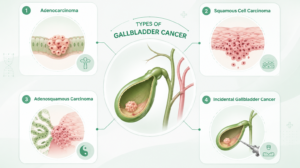
1. Adenocarcinoma
This is the most common type, which accounts for the vast majority of gallbladder cancers. It originates in the mucus-secreting glandular cells of the gallbladder wall.
2. Squamous Cell Carcinoma
A less common type that arises from the squamous cells mixed in with glandular cells in the gallbladder lining. It tends to be more aggressive and responds differently to treatment.
3. Adenosquamous Carcinoma
A mixed type showing features of both adenocarcinoma and squamous cell carcinoma. It is rare and generally carries a poorer outlook.
4. Incidental Gallbladder Cancer
This is not a separate histological type but deserves special mention. Many gallbladder cancers in India are discovered unexpectedly after a routine laparoscopic cholecystectomy (gallbladder removal) done for gallstones. These incidental cancers are typically early-stage and, when managed correctly by an expert HPB specialist, carry the best outcomes of any gallbladder cancer presentation.
Reach Out for Expert Care
Who Is at Risk of Gallbladder Cancer?
Recognising risk factors is important for monitoring high-risk individuals and for understanding why certain patients need specialist follow-up after gallbladder treatment.
Common risk factors include:
-
- Gallstones (cholelithiasis) – Especially large stones over 3 cm present for many years
- Gallbladder polyps – particularly those larger than 1 cm, which carry malignant potential
- Porcelain gallbladder – Calcium deposits on the gallbladder wall
- Chronic gallbladder inflammation
- Primary sclerosing cholangitis
- Anomalous pancreaticobiliary ductal junction (APBDJ) – A congenital anatomical variant that is an important and under-recognised risk factor in the Indian population
- Typhoid carriers
- Obesity and a sedentary lifestyle
- Exposure to certain industrial chemicals
India, particularly the northern belt covering Uttar Pradesh, Bihar, Rajasthan, and parts of Haryana, has one of the highest incidence rates of gallbladder cancer in the world. This makes awareness of symptoms and risk factors especially important for patients in these regions.
Symptoms of Gallbladder Cancer
As early-stage gallbladder cancer causes no symptoms, most patients present only when the disease has progressed. Recognising these warning signs early and seeking evaluation from a top gallbladder cancer specialist in India can still make a meaningful difference to treatment options.
Common symptoms include:
- Persistent pain in the upper right abdomen
- Jaundice
- Dark urine and pale or clay-coloured stools
- Itching due to bile salts accumulating under the skin
- Unexplained weight loss and loss of appetite
- Nausea and a persistent feeling of fullness
- A palpable lump in the upper right abdomen
- Fever in more advanced cases
Jaundice appearing alongside a known gallbladder mass is a serious sign that requires urgent specialist evaluation. Do not delay seeking care if these symptoms are present, as untreated biliary obstruction can lead to infection, liver damage, and sepsis.
Advanced Diagnosis for Gallbladder Cancer in India
Accurate diagnosis is essential for deciding the right treatment approach. At Paras Health Gurugram, patients benefit from a full range of advanced diagnostic tools to guide surgical planning.
Diagnostic tests include:
- Ultrasound of the abdomen – First-line investigation; identifies gallbladder wall thickening, masses, and surrounding involvement
- Contrast-enhanced CT scan – Detailed assessment of tumour extent, liver involvement, lymph nodes, and nearby blood vessels
- MRI with MRCP – Maps biliary anatomy before complex resections
- PET-CT scan – Used selectively to assess for distant metastases when suspected on standard imaging
- ERCP – Endoscopic evaluation of the bile duct with biopsy capability
- CT-guided fine needle aspiration (FNAC) – Tissue diagnosis when surgery is not the first step
- Tumour markers – Support diagnosis and post-treatment monitoring
Dr. Ankur Garg personally evaluates complex cases to ensure precise s treatment planning before any procedure is recommended.
Staging of Gallbladder Cancer
Staging follows the AJCC TNM system (for classifying the extent of cancer ) and is the single biggest determinant of what treatment is possible and what outcomes can be realistically expected.
| STAGE | What it means |
| Stage I | Cancer confined to the innermost layer of the gallbladder wall |
| Stage II | Cancer has grown into deeper layers of the wall, possibly into the perimuscular tissue |
| Stage III | Spread to the liver, adjacent organs (stomach, colon), or nearby lymph nodes |
| Stage IV | Spread to major blood vessels or distant organs |
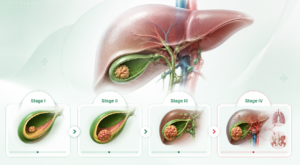
Early-stage disease (Stage I and II) is treated with curative intent. Stage III and IV disease requires a combination of surgery, systemic treatment, and, in some cases, palliative care, tailored to the individual patient.
Reach Out for Expert Care
Comprehensive Gallbladder Cancer Treatment Options in India
Gallbladder cancer treatment ranges from surgery in early-stage disease to systemic therapies, targeted agents, and palliative interventions in advanced cases. At LivCure, under the guidance of Dr. Ankur Garg, a leading HPB surgeon in India, every patient receives a personalised treatment plan based on their stage, anatomy, and overall health.
1. Surgical Treatment for Gallbladder Cancer
Surgery is the only treatment that offers the possibility of a cure, and the type of surgery depends entirely on the stage and extent of the tumour.
Simple Cholecystectomy
- Appropriate for very early-stage disease (T1a), confined to the innermost layer
- Many of these cases are discovered incidentally after laparoscopic gallbladder surgery for stones
- No further surgery is needed if the pathology margins are clear
Radical or Extended Cholecystectomy
- Standard surgical approach for Stage T1b and beyond
Involves removing:
- The gallbladder
- A margin of liver tissue
- Regional lymph nodes in the hepatoduodenal ligament
- The common bile duct in selected cases
Major Liver Resection with Bile Duct Reconstruction
- Required when the tumour has invaded the liver or bile ducts more extensively
- A complex operation that demands HPB surgical experience and robust ICU support
- Dr. Ankur Garg and the LivCure team have extensive experience in these advanced hepatectomy surgeries in Gurgaon
Port-Site Excision
- Performed in patients who previously had a laparoscopic cholecystectomy and are later found to have cancer
- Done because tumour cells can seed at the trocar sites used during the original operation
For selected early-stage cases with favourable anatomy, the team also offers minimally invasive and laparoscopic approaches that reduce recovery time and post-operative discomfort.
When Surgery Is Not Possible
In some patients, gallbladder cancer may be too advanced for safe removal at the time of diagnosis. In these situations, treatment focuses on controlling the disease and improving quality of life.
Treatment options may include:
- Chemotherapy to help slow tumour growth and manage symptoms
- Targeted therapy or immunotherapy in selected patients based on molecular testing
- Biliary stenting or drainage procedures to relieve jaundice and improve bile flow
- Pain and symptom management for better daily comfort and quality of life
- Nutritional and supportive care to help maintain strength during treatment
- Palliative care support for symptom relief and overall patient well-being
At Paras Health, every patient receives an individualised treatment plan based on the stage of disease, symptoms, and overall health status.
Why Choose Dr. Ankur Garg for Gallbladder Cancer Treatment in India?
Choosing the right specialist is the most important decision a patient with gallbladder cancer will make. The liver, bile ducts, and gallbladder are anatomically interconnected, and cancers in this region require a surgeon who understands the entire hepatobiliary system.
Key highlights:
- 25+ years of experience in HPB surgery and liver transplantation
- 4,500+ hepatobiliary and GI procedures performed, including complex biliary cancer resections
- Expertise in bile duct surgery, major liver resections, and biliary reconstruction
- Skilled in both laparoscopic and robotic HPB surgery in Gurgaon
- Every case is reviewed by a multidisciplinary tumour board before any treatment begins
- Centres at Paras Health Gurugram, Panchkula, and Patna serving patients across north and eastern India and international patients from South Asia and the Gulf
Take the Next Step Toward the Right Gallbladder Cancer Care
A gallbladder cancer diagnosis is overwhelming, but the steps you take in the first few weeks matter enormously. Whether you are newly diagnosed, unsure about a treatment plan you have received, or seeking a second opinion, the LivCure team is here to help you navigate your options with clarity and honesty.
- A second opinion on gallbladder cancer diagnosis or treatment planning
- Evaluation for surgical eligibility, including complex resection cases
- Guidance on chemotherapy, targeted therapy, or palliative care options
- Incidental gallbladder cancer discovered after cholecystectomy for stones
Every consultation begins with a detailed clinical assessment and a clear, personalised plan tailored to your stage, anatomy, and overall health. At Paras Health, patients benefit from advanced diagnostics, minimally invasive surgical options where appropriate, and complete HPB oncology care in India.
Medical Disclaimer: This content is for informational purposes only and does not constitute medical advice. All treatment decisions should be made in consultation with a qualified healthcare professional after a complete clinical evaluation.

Dr. Ankur Garg's Medical Content Team
Dr. Ankur Garg’s medical content team specialises in creating accurate, clear, and patient-focused healthcare content. With strong clinical understanding and expertise in technical writing and SEO, the team translates complex medical information into reliable, accessible resources that support informed decisions and uphold Dr. Ankur Garg’s commitment to quality care.

 WhatsApp