
Liver Transplant in Delhi NCR
A liver transplant replaces a failing liver with a healthy donor liver. In Delhi NCR, one-year survival rates reach 85-90% at experienced centers. It’s recommended for end-stage liver disease, cirrhosis, acute liver failure, and liver cancers.
Introduction
When the liver stops working, very little else in the body can compensate for it. The liver handles over 500 functions, including filtering toxins, producing clotting proteins, and processing nutrients. When advanced disease destroys enough of this tissue, medicine alone can no longer keep a patient stable.
Liver transplant in Delhi NCR is now available at several high-volume programmes operating across Gurugram, Noida, and the wider NCR region. The region has the infrastructure, the surgical expertise, and the transplant ICU capacity to manage even the most complex cases.
Dr. Ankur Garg leads a dedicated transplant team at Paras Hospital, Gurugram, with 25+ years of experience and over 4,500 liver transplant procedures performed.
If you or a family member has been told a transplant may be needed, the most important thing you can do right now is get a proper evaluation. Early consultation improves surgical eligibility and long-term outcomes.
Book a consultation with Dr. Ankur Garg
What Is a Liver Transplant and When Is It Needed?
A liver transplant is a surgery that removes a diseased liver and replaces it with a healthy one from a living or deceased donor. It’s recommended when the liver has sustained irreversible damage and can no longer perform its essential functions, and when no other medical treatment can manage the condition.
The most common reasons patients need a liver transplant in Delhi NCR include:
- End-stage liver disease and advanced liver cirrhosis
- Acute liver failure (sudden, severe loss of liver function)
- Chronic hepatitis B or hepatitis C-related liver damage
- Non-alcoholic fatty liver disease (NAFLD) that has progressed to cirrhosis
- End-stage liver disease caused by alcohol-related damage
- Liver cancer that meets transplant criteria (typically within Milan or UCSF criteria)
- Metabolic and genetic liver disorders
Doctors assess transplant urgency using the MELD score (Model for End-Stage Liver Disease), a number calculated from three routine blood tests: bilirubin, creatinine, and INR. Patients with a MELD score above 10, or those developing complications like intractable ascites, variceal bleeding, or hepatic encephalopathy, are typically referred for transplant evaluation.
Reach Out for Expert Care
What Is a MELD Score and What Does Yours Mean?
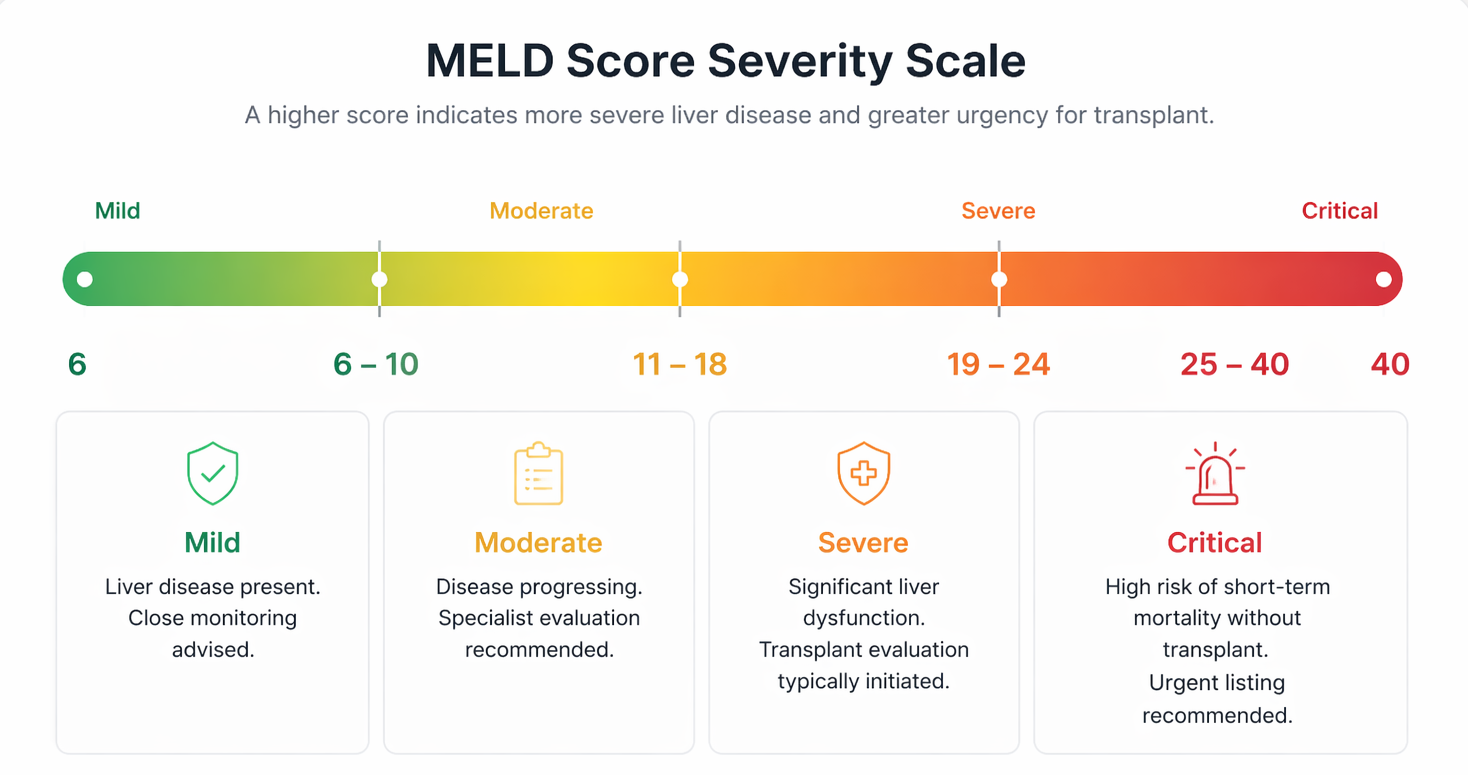
A MELD score (Model for End-Stage Liver Disease) is a number between 6 and 40 that tells your doctor how urgently your liver needs to be replaced.
It’s calculated from three routine blood tests: bilirubin (how well your liver clears waste), creatinine (how well your kidneys are working), and INR (whether your liver is still producing clotting proteins). The higher the score, the more the liver is struggling, and the higher the priority for transplant.
Doctors use the MELD score alongside the full clinical picture to guide treatment decisions. It’s one of the most important numbers in liver transplant planning, and understanding it helps patients and families have more informed conversations with their medical team.
| MELD Score | Disease Severity | General Clinical Indication |
| 6-10 | Mild | Liver disease present. Close monitoring advised. Transplant usually not indicated at this stage. |
| 11-18 | Moderate | Disease progressing. Specialist evaluation recommended. Living donor transplant may be discussed. |
| 19-24 | Severe | Significant liver dysfunction. Formal transplant evaluation typically initiated. |
| 25-40 | Critical | High risk of short-term mortality without transplant. Urgent listing generally recommended. |
A few things worth knowing about this score:
- It changes over time
The MELD score is not a fixed number. It goes up or down depending on how the disease is progressing, which is why regular blood tests matter.
- It’s one tool among several
The MELD score doesn’t capture everything. Symptoms like recurrent ascites, hepatic encephalopathy, or gastrointestinal bleeding carry clinical weight even when the score appears moderate.
- It is not a verdict
A high MELD score is serious, but it is also the clearest signal that the right intervention at the right time can still make a difference.
If you have a recent blood test report and want to understand what your MELD score means for your specific situation, the most reliable step is a direct consultation with a liver transplant specialist in Delhi NCR. General ranges offer context; your clinical picture tells the real story.
Warning Signs of Liver Problems You Shouldn’t Ignore
If you notice any of the following symptoms in yourself or a family member, see a liver transplant specialist in Delhi NCR without delay. These signs often indicate that the liver is failing and that time matters:
- Persistent jaundice (yellowing of skin and eyes)
- Ascites (swelling of the abdomen from fluid buildup)
- Hepatic encephalopathy, which means confusion, forgetfulness, or altered behaviour caused by toxins that the liver can no longer clear
- Recurrent vomiting of blood or black stools (signs of gastrointestinal bleeding)
- Severe, unexplained fatigue that doesn’t improve with rest
- Repeated infections or a very poor response to treatment
Many families wait too long before seeking a specialist opinion. By the time some of these symptoms are severe, a patient’s surgical eligibility may already be affected. Early referral allows the transplant team to address and resolve pretransplant complications while the patient’s liver disease is still relatively controlled.
Types of Liver Transplant Available in Delhi NCR
Living Donor Liver Transplant (LDLT)
- It is the most common type performed in Delhi NCR and across India. A healthy family member or compatible donor donates a portion of their liver, which is then transplanted into the patient.
- LDLT is possible for all types of recipients and indications. This option avoids long waiting times and allows the surgery to be planned carefully.
Deceased Donor Liver Transplant (DDLT)
- It uses a complete liver from a brain-dead donor, allocated through the government’s organ sharing network.
- In Delhi NCR, organ allocation for deceased donor livers follows the official NOTTO protocol, which prioritises patients by medical urgency and MELD score.
Paediatric Liver Transplant
- A type of transplant that requires additional surgical expertise and dedicated ICU support for children. It’s used for conditions like biliary atresia, metabolic liver disorders, and acute liver failure in children.
- If your child has been diagnosed with a serious liver condition, early referral to a centre experienced in paediatric transplants is particularly important.
For patients whose blood type doesn’t match a willing donor, an ABO incompatible liver transplant may also be an option.
How Does the Liver Transplant Process Work, Step by Step?
A liver transplant involves four stages: pre-transplant evaluation, surgery, ICU recovery, and long-term follow-up. The full process from first consultation to discharge typically takes three to six weeks, with ongoing monitoring continuing for life.
- Pre-transplant evaluation is the starting point. Both the recipient and (if applicable) the living donor undergo blood tests, imaging (CT scan and MRI), liver function tests, cardiac evaluation, and a full assessment of overall health.
- This stage confirms whether the patient is fit for surgery and whether the donor liver is suitable for transplant.
- Surgery itself takes between 6 and 12 hours under general anaesthesia. The diseased liver is removed, and the donor liver is connected to the patient’s blood vessels and bile duct.
- This requires precise surgical technique, including vascular reconstruction and bile duct anastomosis. The transplant anesthesia and ICU teams are active throughout.
- Post-operative care begins in the transplant ICU, where patients are monitored closely for the first three to five days. Most patients move to a regular hospital room within a week, provided recovery is progressing well.
- Long-term follow-up includes lifelong immunosuppressant medication (to prevent rejection), regular blood tests, and periodic imaging.
- Staying consistent with follow-up appointments is one of the biggest factors in long-term transplant success.
What to Expect During Recovery After a Liver Transplant
Most patients spend 10 to 21 days in the hospital after a liver transplant, followed by three to six months of structured home recovery. Return to light daily activities is possible within six to twelve weeks for most patients, with full recovery taking slightly longer for some.
- The survival outcomes from liver transplant in India are now comparable to international standards. One-year survival rates in India range from 85% to 90%, and five-year survival rates range from 70% to 75%, driven by advanced surgical techniques and structured postoperative care.
- With proper long-term care, more than 70% of patients live ten years or longer after the procedure.
- Patients should avoid alcohol completely after a transplant. A liver-friendly diet, regular light physical activity, and consistent adherence to immunosuppressant medication are the three habits that matter most for long-term outcomes.
Why Choose Dr. Ankur Garg for Liver Transplant in Delhi NCR
Choosing the right surgical team for a liver transplant is one of the most consequential decisions a family will make. It’s not just about the surgeon’s skill on the day of the operation. It’s about the pre-transplant evaluation, the quality of the ICU care, the anaesthesia expertise, and the structured follow-up that continues for years afterward.
Dr. Ankur Garg brings 25+ years of transplant and HPB (Hepato-Pancreato-Biliary) surgery experience, with 4,500+ liver transplant procedures performed and a 95% success rate. He works alongside a full multidisciplinary team at Paras Hospital, Gurugram, one of Delhi NCR’s established tertiary care transplant centres.
Every patient goes through a structured transplant pathway: detailed evaluation, multidisciplinary case review, surgery with a dedicated transplant anaesthesia team, transplant ICU monitoring, and organised long-term follow-up. Nothing is left to chance.
If you’ve been told you or a family member may need a liver transplant, the first step is a proper specialist evaluation. Don’t delay that conversation.
Book your consultation with Dr. Ankur Garg today
Reach Out for Expert Care
A Case That Reflects What Early Evaluation Can Do
A 52-year-old patient from Ghaziabad was referred to Dr. Ankur Garg at Paras Hospital, Gurugram, with advanced liver cirrhosis secondary to hepatitis B. His MELD score at the time of first consultation was 22. He had developed ascites and had required two hospitalisations in the three months prior to reaching LivCure. Two other centres had advised against surgery, citing high operative risk.
Dr. Garg’s team conducted a full transplant evaluation. The patient’s younger brother was assessed as a potential living donor and cleared after a thorough investigation. A liver transplant was performed without major intraoperative complications. The patient spent four days in the transplant ICU at Paras Hospital before being moved to a regular room. He was discharged on day 14.
At his six-month follow-up, liver function tests were within normal range. He has since returned to his daily routine and no longer requires hospitalisation for fluid management. His brother returned to work within eight weeks of donation.
Dr. Garg’s team notes that this case is not unusual. In most cases, what changes the outcome is not the complexity of the surgery alone. It’s how early the right evaluation happens.
Ready for a Liver Transplant in Delhi NCR? Start Here
A liver transplant in Delhi NCR is a well-established, life-saving procedure with strong outcomes at experienced centres. The key is timing: the earlier a patient gets evaluated, the more options are available, and the better the surgical outcome tends to be.
Whether you’re dealing with advanced cirrhosis, acute liver failure, or a liver cancer diagnosis, the first call to make is to a transplant specialist who can give you a clear picture of where things stand and what the right path forward looks like.
Dr. Ankur Garg and the LivCure team at Paras Hospital, Gurugram, are available for consultation. Reach us at +91 87002 71068 or book an appointment online.

Dr. Ankur Garg's Medical Content Team
Dr. Ankur Garg’s medical content team specialises in creating accurate, clear, and patient-focused healthcare content. With strong clinical understanding and expertise in technical writing and SEO, the team translates complex medical information into reliable, accessible resources that support informed decisions and uphold Dr. Ankur Garg’s commitment to quality care.

 WhatsApp