
SWAP Liver Transplant in India
A SWAP Liver Transplant in India, also known as Liver Paired Exchange (LPE), is an advanced and legally approved transplant solution for patients who have a willing donor but face blood group incompatibility.
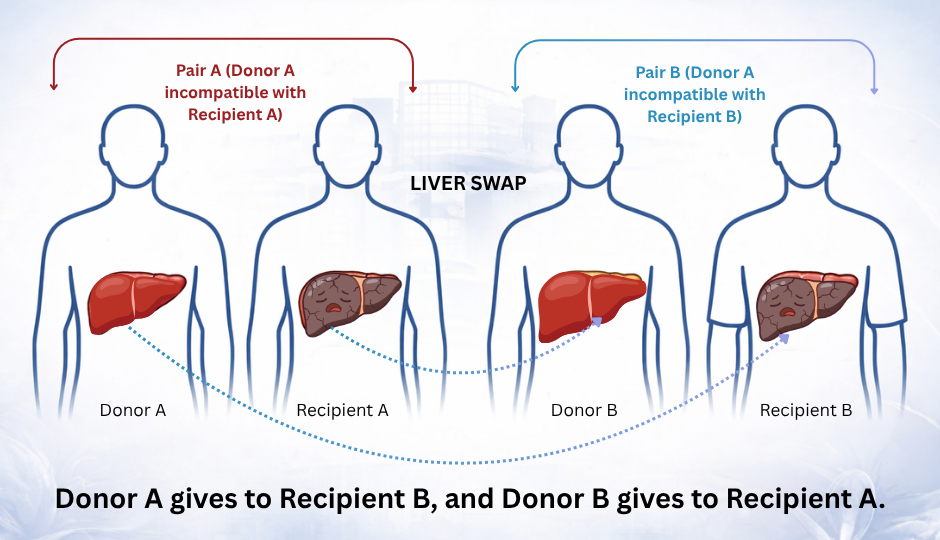
Instead of rejecting the donor, two families exchange donors so that each patient receives a compatible liver transplant, making the procedure safer and more effective than ABO-incompatible transplants.
With highly experienced surgeons like Dr. Ankur Garg in Gurugram, India has become a leading destination for SWAP liver transplants due to high success rates, structured protocols, and significantly lower costs.
👉 If your donor is not a match, book a consultation today to explore SWAP transplant eligibility.
Introduction
Most families facing a liver transplant in India run into the same wall: a willing donor whose blood group simply doesn’t match. It feels like a dead end. It isn’t.
A SWAP liver transplant exists precisely for this situation. Two families, both with incompatible donors, exchange donors, so each patient receives a liver from a compatible donor. The procedure is legal, regulated, and increasingly performed at specialist centres across India.
India has over 25,000 deaths annually from liver failure, and donor incompatibility is one of the most common reasons transplants don’t happen. Understanding your options early can make the difference between a transplant that’s possible and one that isn’t.
This page covers everything you need to know about the procedure, who qualifies, how it’s governed under Indian law, and what to expect at every stage.
What Is a SWAP Liver Transplant?
In a SWAP liver transplant, two incompatible living donor–recipient pairs agree to exchange their donors. Each donor gives part of their liver not to a family member, but to another patient, resulting in two compatible transplants that would otherwise not have been possible.
The concept works because the liver is the only organ in the body that regenerates. A donor gives roughly 60% of their liver; within three months, both the donated portion and the remaining portion regenerate to full size in both the donor and the recipient.
The simplest form is a two-way swap: four people enter four operating theatres simultaneously: two donors and two recipients with two independent surgical teams working in parallel. More complex versions involve three-way or even larger chains.
The most common reason families need a SWAP is an ABO blood group mismatch. In India, this is particularly common between blood group A and blood group B families. If Family 1 has a blood group A donor and a blood group B patient, and Family 2 has the reverse, a swap resolves both incompatibilities cleanly.
A SWAP can also help when the donor’s liver is too small for the recipient’s body weight, a mismatch known as an inadequate graft-to-recipient weight ratio (GRWR). In these cases, finding a second pair in which the liver sizes are complementary allows both transplants to proceed safely.
Reach Out for Expert Care
Who Is a Good Candidate for a SWAP Liver Transplant?
A SWAP liver transplant is the right option when a patient has a willing living donor who is otherwise healthy, but is either blood-group incompatible or has a liver size mismatch with the recipient. Both the patient and donor must meet standard transplant eligibility criteria, and a second compatible swap pair must be identified.
On the recipient side, common conditions that lead to a SWAP transplant include:
- End-stage liver disease
- Liver cirrhosis from alcohol, hepatitis B/C, NAFLD, or autoimmune causes
- Liver cancer (hepatocellular carcinoma within accepted transplant criteria)
- Acute liver failure when a living donor is immediately available
- Genetic or metabolic liver disorders
The patient’s MELD score (Model for End-stage Liver Disease) is used to assess the urgency of care. A higher MELD score signals more severe disease and greater urgency for transplantation. There’s no upper MELD limit that rules a SWAP out entirely, but the clinical team will weigh urgency against the time needed to identify and coordinate a compatible swap pair.
On the donor side, anyone being considered must be between 18 and 55 years old, in good physical health, free from HIV, active hepatitis, cancer, uncontrolled diabetes, or significant cardiac disease, and with a BMI that allows safe liver donation. Under THOA Rules 2014, the donor must be a near relative of the recipient; this includes parents, children, siblings, spouse, and grandparents.
When a SWAP is preferred over an ABO-incompatible liver transplant, the transplant team will discuss both options with you and explain what the clinical data show for your specific situation.
Is SWAP Liver Transplant Legal in India?
Yes. SWAP liver transplants are fully legal in India. The Transplantation of Human Organs (Amendment) Act 2011, followed by the Transplantation of Human Organs and Tissues (THOT) Rules notified in March 2014, explicitly legalized paired exchange transplants between near-relative donor–recipient pairs.
As published in the Indian Journal of Transplantation, Section 3A of the amended THOA Act directly addresses the situation where a near-relative donor is biologically incompatible with their intended recipient and permits a single agreement between two pairs to exchange and receive organs — provided no commercial consideration is involved.
Each SWAP case requires approval from the hospital’s Authorisation Committee, which verifies relationships, confirms informed consent from all four parties (both donors and both recipients), and ensures no financial exchange is involved. At a registered transplant center like Paras Health Gurugram, this process is part of a structured pre-transplant evaluation pathway.
India’s first inter-hospital SWAP liver transplant was performed as recently as July 2025 in Coimbatore, Tamil Nadu, between two hospitals five kilometers apart, and required clearance from the Transplant Authority of Tamil Nadu (TRANSTAN) for the organ to be transported between institutions. This milestone reflects both the legal framework and the growing clinical infrastructure for such procedures.
How Does the SWAP Liver Transplant Process Work
Understanding the full process helps families plan with more confidence. There are no shortcuts, but each step has a clear purpose.
Step 1: Initial evaluation of the patient and the donor
Both the patient (recipient) and their intended donor undergo a comprehensive evaluation. This includes blood group testing, MELD score assessment, liver function tests, CT volumetry (to measure liver size), cardiac clearance, and psychiatric evaluation for the donor. This phase typically takes one to three weeks.
Step 2: Identifying a compatible swap pair
This is the step that requires the most coordination. The transplant team or a regional/national registry identifies another donor–recipient pair whose blood groups are complementary. In a two-way swap, Donor 1 is compatible with Recipient 2, and Donor 2 is compatible with Recipient 1.
Step 3: Joint evaluation of both pairs
Once a potential swap pair is found, both pairs are evaluated together. All four parties, both donors and both recipients, must be medically suitable, and their respective families must give informed consent independently. Neither pair can withdraw after the other has already started surgery, which is why the Authorisation Committee’s process is thorough.
Step 4: Legal approval from the Authorisation Committee
All four parties appear before the hospital’s Authorization Committee, which verifies documented near-relative relationships, confirms there are no financial arrangements between the families, and grants formal approval under the THOA Rules 2014. This step is non-negotiable.
Step 5: Simultaneous surgery
On the agreed date, all four operations happen concurrently: two donor hepatectomies (removal of a portion of each donor’s liver) and two liver transplants. This requires a minimum of four operating theatres running simultaneously, two independent surgical teams, dedicated anaesthesia teams, and a blood bank equipped to handle the surge.
Step 6: Post-operative monitoring
Both recipients spend time in the transplant ICU, with round-the-clock monitoring of liver function, bile output, and vascular integrity. Donors are typically discharged within seven to ten days. Recipients usually remain in hospital for three to four weeks before a structured outpatient follow-up programme begins.
SWAP Transplant vs. ABO-Incompatible Liver Transplant: Which Is Better?
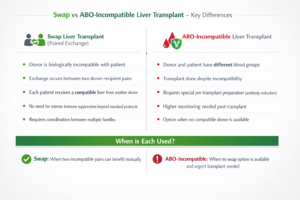
When a direct family donation isn’t blood-group compatible, families are usually offered two options: a SWAP transplant or an ABO-incompatible (ABOi) liver transplant. A SWAP is generally preferred when a compatible pair can be identified, as it avoids the need for desensitisation drugs and carries a lower risk of rejection. An ABOi transplant uses powerful immunosuppressants to override the blood group barrier, but that approach adds infection risk and cost.
Dr. Ankur Garg’s team evaluates both pathways at the initial consultation and will recommend the approach best suited to your situation.
Success Rate of SWAP Liver Transplant in India
When performed at an experienced centre with proper patient selection, SWAP liver transplants deliver strong, reliable outcomes.
| 1-year survival rate | ~90–95% |
| Compared to a standard liver transplant | Comparable outcomes |
| Best results seen at | High-volume, experienced centres |
Outcomes depend on three factors:
- Hospital expertise: Centres with higher transplant volumes and dedicated ICU support consistently produce better results.
- Patient condition: A lower MELD score at the time of surgery is associated with stronger recovery. Early evaluation before the disease reaches a critical stage gives you the best chance.
- Timing of transplant: The sooner a compatible swap pair is identified and surgery is planned, the better the outcome. Delayed transplantation in a deteriorating patient adds risk for everyone involved.
Risks and Complications of a SWAP Liver Transplant in India
Like any major surgery, a SWAP liver transplant carries risks for both the donors and the recipients. These are well understood, and a structured transplant programme significantly reduces them.
For recipients, the main risks are:
- Graft rejection: The immune system may attempt to attack the new liver. Anti-rejection medications (immunosuppressants) are started immediately after surgery and continued long-term.
- Infection: Because immunosuppressants reduce immune function, recipients are more vulnerable to bacterial, viral, and fungal infections, particularly in the first three to six months.
- Biliary complications: Bile duct leaks or strictures can occur at the surgical site where the bile duct is reconnected.
- Vascular complications: Hepatic artery or portal vein issues, though rare at high-volume centres.
For donors, risks are lower but real. Donor hepatectomy carries a complication rate of roughly 9% to 24%, depending on the type of donation, with serious complications far less common. Most donors are discharged within 7 to 10 days and return to normal activity within 4 to 6 weeks.
What reduces risk: Volume of experience, a dedicated transplant ICU, a multidisciplinary team with specialised transplant anaesthesia, and meticulous pre-operative evaluation. These are the foundations of a structured transplant programme.
Reach Out for Expert Care
Why Choose India for a SWAP Liver Transplant?
India has quietly become one of the most sought-after destinations for liver transplantation and for good reason. Patients from across South Asia, the Middle East, Africa, and beyond travel to India specifically because the combination of clinical expertise, infrastructure, and affordability is difficult to match anywhere else in the world.
| Surgeon experience | Some of the highest-volume transplant surgeons globally |
| Transplant infrastructure | Dedicated ICUs, multi-theatre facilities, specialised teams |
| Cost advantage | 60–80% lower than the US, UK, or Australia |
| Success rates | Comparable to leading international centres |
| Treatment access | Faster scheduling with living donors vs. long deceased donor wait lists abroad |
With a willing living donor, patients in India can often move from evaluation to surgery in four to eight weeks, a timeline that most Western healthcare systems simply can’t offer for transplant cases.
Delhi NCR and Gurugram in particular have emerged as leading hubs for transplant care, with internationally accredited hospitals, experienced multidisciplinary teams, and strong post-operative support infrastructure. For international patients, the region also offers English-speaking medical teams, straightforward medical visa pathways, and proximity to international airports.
Why Choose Dr. Ankur Garg for SWAP Liver Transplant in India?
When it comes to a procedure as complex as a SWAP liver transplant, the surgeon and centre you choose matter as much as the decision to transplant itself. Here’s what sets Dr. Ankur Garg’s programme at Paras Health, Gurugram apart.
| Experience | 25+ years in liver transplantation and HPB surgery |
| Volume | 4,500+ liver transplants performed |
| SWAP expertise | Handles complex paired exchange cases, including ABO-incompatible scenarios |
| Team | Full multidisciplinary team: hepatologists, transplant anesthetists, ICU specialists, transplant coordinators |
| ICU support | Dedicated transplant ICU with round-the-clock post-operative monitoring |
| Success rate | 95% overall transplant success rate |
| Post-op care | Structured outpatient follow-up with regular liver function testing and immunosuppression management |
When a family comes with a willing but incompatible donor, our evaluation begins straight away. We assess the patient’s disease severity, the donor’s suitability, and whether a SWAP pair can be identified through our network. Both pairs are evaluated together, and the Authorisation Committee process is coordinated for you.
If a SWAP is not immediately possible or time is a factor, we discuss all available alternatives, including ABO-incompatible transplantation, with full transparency about the clinical tradeoffs. No family is left without a clear path forward.
For families travelling from outside Delhi NCR or from abroad, our international patient team handles medical documentation, visa support letters, and full coordination between your local doctors and ours.
To start your evaluation, book a consultation with Dr. Ankur Garg at Paras Health, Gurugram.
Final Thoughts
A SWAP liver transplant turns an apparent dead end, a willing but incompatible donor, into a viable path to transplant. It’s legal, protocol-driven, and at experienced centres, it produces outcomes comparable to standard living donor liver transplantation.
Three things matter most if you’re exploring this route. First, start the evaluation early: the time needed to identify a compatible swap pair means you can’t afford to wait until the patient’s condition is critical. Second, choose a centre with the infrastructure for simultaneous four-operating-room surgery and a dedicated transplant ICU. Third, get clarity on all your options: SWAP, ABO-incompatible transplantation, and deceased donor transplantation, so your family can make an informed decision.
Speak to Dr. Ankur Garg’s team at Paras Health, Gurugram, for a full evaluation. The sooner we assess your situation, the more options remain open to you.

Dr. Ankur Garg's Medical Content Team
Dr. Ankur Garg’s medical content team specialises in creating accurate, clear, and patient-focused healthcare content. With strong clinical understanding and expertise in technical writing and SEO, the team translates complex medical information into reliable, accessible resources that support informed decisions and uphold Dr. Ankur Garg’s commitment to quality care.

 WhatsApp