
Hepatitis B Treatment in India
Hepatitis B is one of the most common causes of chronic liver disease in India. Most people carry it for years without knowing, until a routine blood test or an ultrasound flags it.
The good news: with the right antiviral treatment, Hepatitis B can be completely suppressed. Most patients live a normal life. The risk comes when it is left untreated for too long, leading to liver cirrhosis, liver failure, or liver cancer.
This page explains what Hepatitis B does to the liver, how it is diagnosed, what options are available for Hepatitis B treatment in India, and when a liver transplant becomes necessary.
What Is Hepatitis B?
Hepatitis B is a viral infection caused by the Hepatitis B Virus (HBV). It attacks liver cells directly, causing inflammation that, over time, leads to scarring and permanent damage of liver.
There are two forms:
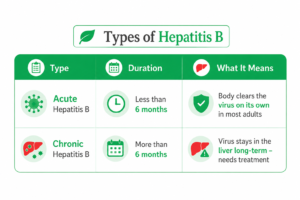 In India, the majority of chronic Hepatitis B cases are acquired at birth or in early childhood, which is why many patients reach adulthood without ever knowing they carry the virus.
Stages of Hepatitis B Infection
Understanding the stage helps determine whether treatment is needed immediately or if monitoring is sufficient.
- Immune Tolerant Phase: Liver damage is minimal at this stage. Common in children and young adults who acquired it at birth.
- Immune Active Phase (HBeAg Positive): This is when liver damage accelerates. Treatment is usually started here.
- Inactive Carrier Phase: Virus is suppressed, either naturally or with treatment. Liver enzymes are normal. Regular monitoring still required.
- Reactivation Phase (HBeAg Negative): Virus mutates and becomes active again despite earlier suppression. Often more aggressive. Needs antiviral treatment.
- Cirrhosis / End-Stage Liver Disease: Years of unchecked inflammation lead to permanent scarring. At this point, treatment focuses on managing complications and evaluating for liver transplant.
See Liver Cirrhosis Treatment in Gurgaon.
Reach Out for Expert Care
Symptoms of Hepatitis B
In most chronic cases – no symptoms at all.
That is the dangerous part. The liver silently scars for years. By the time symptoms appear, damage has already occurred.
When symptoms do appear, they include:
- Fatigue that doesn’t go away with rest
- Yellowing of eyes or skin (jaundice)
- Upper right abdominal discomfort
- Dark urine and pale stools
- Loss of appetite and nausea
- Mild fever (more common in acute Hepatitis B)
Signs that liver damage is advanced:
- Abdominal swelling (ascites – fluid in the belly)
- Confusion or drowsiness (Hepatic Encephalopathy)
- Vomiting blood or black tarry stools
- Significant weight loss
- Easy bruising or bleeding
These are signs of acute liver failure or decompensated cirrhosis requiring immediate specialist evaluation.
How Does Hepatitis B Spread?
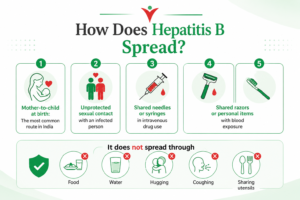
Diagnosis of Hepatitis B in India
A diagnosis of Hepatitis B requires a specific set of blood tests
Blood Tests
HBsAg (Hepatitis B Surface Antigen): The primary screening test. If positive, the virus is present in the body.
HBeAg and Anti-HBe: Tells whether the virus is actively replicating or in a lower activity phase.
HBV DNA (Viral Load): Measures the actual amount of virus in the blood.
LFT (Liver Function Tests): ALT and AST levels show whether liver cells are inflamed.
Read the LFT Test Explained in Simple Language.
Anti-HBs (Hepatitis B Surface Antibody): Confirms immunity, either from past infection that resolved or from vaccination.
Alpha-Fetoprotein (AFP): A tumour marker checked every 6 months in all Hepatitis B patients early detection of liver cancer (HCC).
Imaging
Ultrasound Abdomen: First-line imaging. Checks liver texture, size, and looks for early signs of cirrhosis, portal hypertension, or masses.
FibroScan: Non-invasive test that measures liver stiffness, tells how much fibrosis (scarring) has accumulated without needing a biopsy.
Very useful for deciding whether treatment is urgent.
CT Scan / MRI Abdomen: Used when a mass or suspicious lesion is found on ultrasound, or to assess advanced cirrhosis in detail.
Liver Biopsy: In selected cases where the stage of disease is unclear despite blood tests and imaging. Provides a direct assessment of inflammation grade and fibrosis stage.
Hepatitis B Treatment in India
The goal of Hepatitis B treatment is not to eliminate the virus completely (which is very difficult), it is to suppress viral replication to undetectable levels, stop liver damage, and prevent progression to cirrhosis or cancer.
Who Needs Antiviral Treatment?
Not every Hepatitis B carrier needs immediate medication. Treatment is recommended when:
- HBV DNA is above 2,000 IU/mL with elevated liver enzymes
- There is evidence of significant liver inflammation or fibrosis on FibroScan
- The patient has cirrhosis
- HBV DNA is above 20,000 IU/mL even with normal enzymes, if over age 30
- Patient is immunosuppressed (on chemotherapy, steroids, or post-transplant)
Hepatitis B and Liver Cirrhosis
Chronic, untreated Hepatitis B is one of the leading causes of liver cirrhosis in India.
As HBV keeps triggering immune-mediated liver cell destruction, year after year, scar tissue replaces functional liver tissue. Patients with Hepatitis B-related cirrhosis need antiviral therapy regardless of viral load and need 6-monthly ultrasound + AFP screening for liver cancer without exception.
Hepatitis B and Liver Cancer (HCC)
Hepatitis B is the single largest cause of hepatocellular carcinoma (HCC) in India and globally.
If liver cancer is detected early, surgical resection or ablation therapy offers a curative outcome. In patients with underlying cirrhosis, a liver transplant may offer better long-term results than resection.
See Liver Cancer Treatment in Gurgaon.
Reach Out for Expert Care
When Does Hepatitis B Require a Liver Transplant?
Antiviral therapy controls Hepatitis B effectively in most patients. A liver transplant is considered only when the liver has been damaged beyond recovery.
A transplant is evaluated when:
- Hepatitis B has progressed to end-stage liver disease (MELD score ≥ 15–20)
- Decompensated cirrhosis, repeated ascites, encephalopathy, or variceal bleeding despite treatment
- Acute liver failure from Hepatitis B reactivation that does not respond to antiviral therapy within 48-72 hours
- HCC within Milan criteria (early-stage liver cancer where transplant gives better outcomes than resection)
Dr. Ankur Garg performs Living Donor, Deceased Donor, and ABO-Incompatible Liver Transplants at Paras Hospital, Gurgaon. If you are unsure whether a transplant is the right step, a second opinion before liver transplant can help your family decide with clarity.
Hepatitis B Vaccination – Who Should Get It?
The Hepatitis B vaccine is one of the most effective vaccines ever developed – it provides over 95% protection.
Who should be vaccinated:
- All newborns – first dose within 24 hours of birth
- Unvaccinated children and adolescents
- Adults who test HBsAg negative and anti-HBs negative (not immune)
- Healthcare workers, dialysis patients, and close contacts of Hepatitis B carriers
- People with multiple sexual partners
- Patients with fatty liver disease or chronic liver conditions
3-dose schedule: 0, 1, and 6 months.
Living with Chronic Hepatitis B: What Patients Need to Know
Do:
- Take antiviral medication every day without missing doses
- Get blood tests (HBV DNA, LFT, AFP) every 6 months
- Get an ultrasound every 6 months
- Inform your doctor before starting any new medication, including herbal supplements
- Get vaccinated for Hepatitis A if not already immune
Avoid:
- Alcohol, even moderate drinking accelerates liver damage in Hepatitis B patients
- Paracetamol beyond 2g/day
- Herbal or Ayurvedic supplements without medical advice
- Stopping antiviral medication without doctor guidance
Why Consult Dr. Ankur Garg for Hepatitis B Treatment in India?
Dr. Ankur Garg is a senior Liver Transplant and HPB Surgeon at Paras Hospital, Gurgaon, with 25+ years of experience managing the full spectrum of Hepatitis B from newly diagnosed carriers to Hepatitis B-related cirrhosis and liver cancer requiring transplant.
The LivCure team includes hepatologists, transplant surgeons, oncologists, and transplant coordinators, meaning whether a Hepatitis B patient needs antiviral monitoring, HCC surveillance, or full transplant evaluation, it all happens under one roof without referral delays.
Patients from across India and from 30+ countries, including South Asia, the Middle East, and Africa consult Dr. Ankur Garg’s team for complex Hepatitis B-related liver disease.
📞 Call: +91 87002 71068 | Book Appointment | Email: info@livcureindia.com
Frequently Asked Questions
Is Hepatitis B related to jaundice? expand_more
Yes active Hepatitis B infection and jaundice often occur together, especially in acute infection or when cirrhosis develops. Persistent jaundice in a Hepatitis B patient needs urgent evaluation.
Can Hepatitis B be cured completely? expand_more
In most chronic cases, a complete cure is rare occurring in about 1-3% of patients per year on treatment. However, viral suppression to undetectable levels is achievable in nearly all patients and effectively stops liver damage.
My HBV DNA is undetectable. Do I still need regular tests? expand_more
Yes. Undetectable viral load means the treatment is working not that the virus is gone. Stopping treatment without medical advice causes rebound. Regular 6-monthly monitoring continues throughout treatment.
Is Hepatitis B treatment lifelong? expand_more
yes, antiviral therapy is continued long-term to prevent relapse.
Can I pass Hepatitis B to my family? expand_more
Yes. Close household contacts especially sexual partners and children should be tested and vaccinated if not already immune.

Dr. Ankur Garg's Medical Content Team
Dr. Ankur Garg’s medical content team specialises in creating accurate, clear, and patient-focused healthcare content. With strong clinical understanding and expertise in technical writing and SEO, the team translates complex medical information into reliable, accessible resources that support informed decisions and uphold Dr. Ankur Garg’s commitment to quality care.

 WhatsApp