
Liver Transplant in Delhi NCR: What to Expect at Every Stage

When a liver transplant becomes a possibility, the operation itself is often the part patients know least about. What usually creates more uncertainty is everything surrounding it – the liver tests, donor evaluation, hospital admission, surgery, ICU stay and life after discharge.
For a family going through this for the first time, the process can feel like a series of decisions arriving all at once. In reality, the liver transplant process in Delhi NCR follows several stages. Each stage gives the transplant team information needed to make the next decision safely.
Understanding what happens at each point can make the journey easier to navigate.
Liver Transplant Evaluation Process: Where It Begins
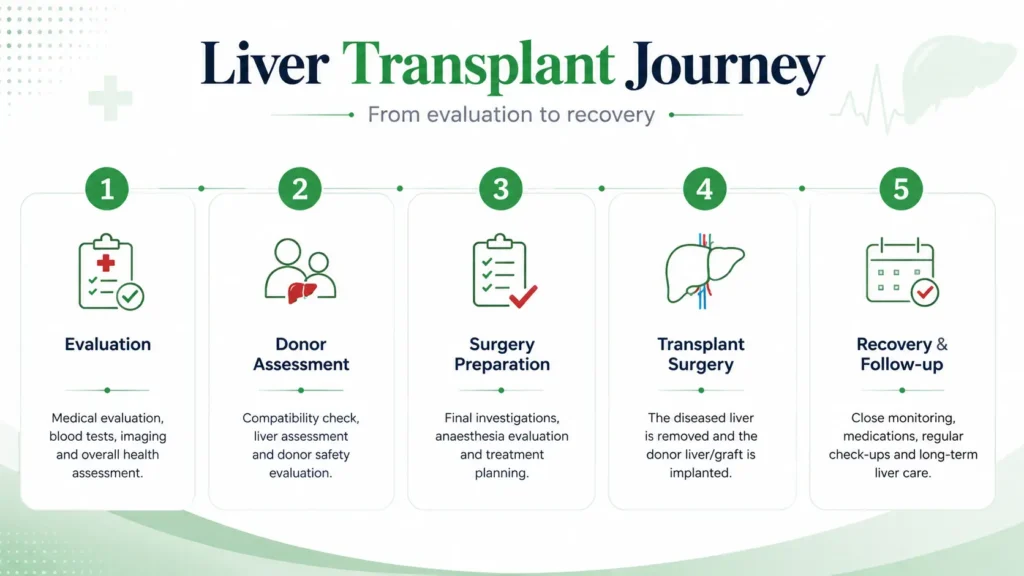
The first step is a detailed assessment of the patient.
During the liver transplant evaluation process, the transplant team reviews the cause and severity of liver disease, previous treatments, medications and any complications such as fluid accumulation, bleeding, jaundice or episodes of confusion.
Blood tests and liver function tests are combined with imaging and other investigations. The heart, lungs, kidneys, nutritional status and overall physical condition may also be assessed because a transplant is major surgery and the patient’s health outside the liver matters too.
This is also the stage when the family can discuss whether transplantation is appropriate, what options may be available and what needs to happen next.
Patients looking for a detailed overview of the treatment can read more on liver transplant in Delhi NCR page.
Request a Consultation
Living Donor Liver Transplant: How Donor Evaluation Works
For a living donor liver transplant, the evaluation involves both the recipient and the potential donor.
A donor is not selected simply because they are a relative or have the same blood group. The donor must undergo a detailed medical assessment to determine whether donation can be performed safely. Blood tests, imaging and anatomical studies help the transplant team understand the donor’s liver and vascular anatomy.
The team also calculates whether the portion of liver donated will be adequate for the recipient while leaving enough liver for the donor.
This stage can take time, and that is intentional. A living donor is a healthy person undergoing major surgery, so protecting the donor’s safety is just as important as planning the recipient’s transplant.
Preparing for Liver Transplant Surgery
Once the evaluation is complete and transplantation is considered suitable, attention turns to surgical preparation.
The transplant team reviews the investigations, manages existing medical problems and completes pre-operative assessments. Anaesthesia evaluation, medication review and additional tests may be required before admission.
Families also begin preparing for the practical side of treatment – hospitalisation, the donor’s admission, communication with the transplant team and the period immediately following surgery.
There is a coordinated plan involving the recipient, donor and multiple members of the transplant team.
What Happens During Liver Transplant Surgery?
The liver transplant surgery process involves removing the diseased liver and replacing it with a donor liver or an appropriate portion of a donor liver.
The operation is performed under general anaesthesia. The transplant surgeon carefully connects the major blood vessels and bile duct of the new liver so that blood can circulate through the graft and bile can drain normally.
The length and complexity of surgery vary from patient to patient. Previous abdominal surgery, the severity of liver disease, bleeding and other medical factors can make some operations considerably more complex than others.
After surgery, the recipient is transferred to the transplant ICU for close monitoring. The donor also receives dedicated post-operative care.
The First Few Days After a Liver Transplant
The immediate period after surgery is closely supervised.
In the transplant ICU, doctors monitor the function of the new liver along with blood pressure, kidney function, oxygen levels, bleeding, infection and other possible complications. Blood tests are performed frequently, and medications are adjusted according to the patient’s condition.
Anti-rejection medicines, or immunosuppressants, become an important part of treatment. These medicines reduce the risk of the immune system attacking the transplanted liver and require careful long-term monitoring.
As the patient’s condition improves, monitoring lines and drains are gradually removed. The patient begins sitting up, eating and moving with assistance before progressing towards independent activity.
Liver Transplant Recovery and Follow-Up
Leaving the hospital is an important milestone, but it is only the beginning of the next phase.
The liver transplant recovery process involves regular blood tests, medication adjustments, follow-up consultations and gradual improvement in strength. The transplant team watches liver function and immunosuppressant levels closely, particularly during the early period.
Patients and families also learn to recognise symptoms that should be reported promptly.
Recovery is not identical for everyone. A patient’s condition before surgery, the type of transplant, complications and general physical health can all influence how quickly normal activities resume.
For a detailed week-by-week look at this period, see our liver transplant recovery timeline.
Choosing a Liver Transplant Surgeon in Delhi NCR
The transplant centre matters, but so does the experience of the surgeon and the wider team managing the patient.
When searching for a liver transplant surgeon in Delhi NCR, patients should consider experience in transplantation, living-donor surgery, complex HPB procedures and management of difficult cases. A transplant programme also requires intensive care, anaesthesia, radiology, hepatology and other supporting specialties working together.
Dr. Ankur Garg is a liver transplant surgeon in Delhi NCR and Group Director & HOD of Liver Transplant & HPB Surgery at Paras Health, Gurugram. He has more than 25 years of experience and has performed over 4,500 liver transplants, with expertise in living-donor and deceased-donor transplantation, ABO-incompatible transplantation, paediatric liver transplantation and combined liver-kidney transplantation. His training includes an MCh from the Institute of Liver & Biliary Sciences, New Delhi, followed by fellowship training with the European Board of Surgery.
Explore Dr. Ankur Garg’s Areas of Clinical Expertise
His previous transplant leadership and consultant roles have included hospitals in Delhi, Gurugram and Faridabad, giving him extensive experience treating patients across the NCR region.
Click here to learn more about Dr. Ankur Garg, liver transplant surgeon in Delhi NCR, including his training, experience and areas of expertise.
Liver Transplant Care for Patients Across Delhi NCR
Patients do not necessarily live close to the transplant centre. Families travel to Gurugram from Delhi, Noida, Ghaziabad and Faridabad, particularly when advanced transplant surgery and specialist care are required.
For someone searching for a liver transplant specialist in Delhi NCR, location is only one consideration. The entire process of evaluation, donor work-up, surgery, ICU care and follow-up needs to be coordinated.
This is especially relevant for patients travelling from Noida or Ghaziabad to Gurgaon, or from Faridabad and Delhi to Gurugram, because transplant care continues well beyond the operation itself.
The most important part of the journey is therefore not simply reaching the operating room. It is having the right decisions made at each stage, from the first evaluation through long-term follow-up.

 WhatsApp