
High SGOT, SGPT & ALP Together? LFT Patterns Explained
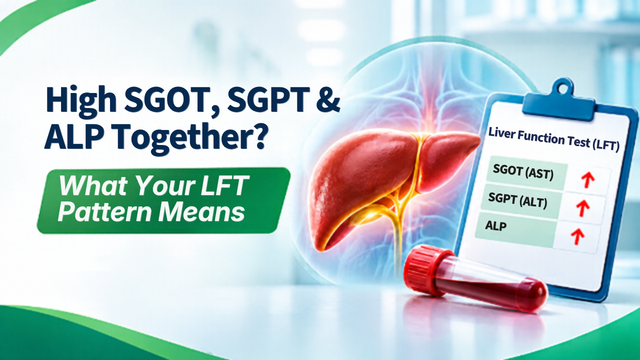
You open your LFT report and three values are flagged in red: SGOT, SGPT and ALP. Panic sets in. Here is what doctors know that the report never tells you: the pattern matters more than any single number. Which enzymes are raised, by how much, and how they move together can point to very different problems, from fatty liver to a gallstone stuck in a bile duct.
In this guide, we walk through the common LFT patterns in plain language. If you only need reference values, start with our LFT normal range guide first.
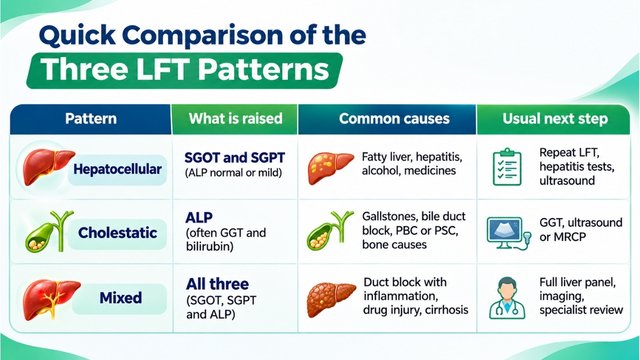
Quick answer: High SGOT and SGPT with a normal ALP usually point to liver-cell injury (a hepatocellular pattern), often from fatty liver, hepatitis, alcohol or medicines. A high ALP with smaller SGOT and SGPT changes suggests a bile-flow problem (a cholestatic pattern). When all three are high, it is a mixed pattern, and your doctor will look at bilirubin, GGT and imaging to find the cause.
Why does the pattern matter more than the number?
SGOT (AST) and SGPT (ALT) are enzymes that leak into your blood when liver cells are irritated or damaged. ALP sits mainly in the lining of the bile ducts, but it is also made in bone. The American College of Gastroenterology (ACG) guideline therefore sorts abnormal results into hepatocellular injury (AST and ALT out of proportion to ALP) and cholestatic injury (ALP out of proportion to AST and ALT), because each leads to a different work-up. It also advises repeating the panel before starting a big investigation, since many mild rises are temporary.
Pattern 1: High SGOT and SGPT, normal ALP
This is the classic liver-cell injury pattern. The usual suspects are fatty liver (now called MASLD), hepatitis B or C, alcohol and medicines.
The ratio gives clues. SGPT higher than SGOT leans towards fatty liver or viral hepatitis, while SGOT at least double SGPT leans towards alcohol-related damage.
How high the numbers are matters too. ACG guidance steps up the work-up at about five times the upper limit, and again above fifteen times. Moderate rises raise suspicion for acute hepatitis, autoimmune hepatitis or drug injury. Very high rises need prompt evaluation, including checks for paracetamol (acetaminophen) toxicity and reduced blood flow to the liver.
Pattern 2: High ALP, normal or mildly raised SGOT and SGPT
Here the problem is usually bile flow. Causes include gallstones, bile duct strictures or tumours, and bile duct diseases such as primary biliary cholangitis and primary sclerosing cholangitis, which the ACG recommends testing for when a high ALP comes from the liver. Some medicines can do it too.
But ALP is not only a liver enzyme. Mayo Clinic notes that bone conditions, healing fractures and pregnancy (especially the last three months) can raise it, and Cleveland Clinic adds that untreated celiac disease may too. The tie-breaker is GGT: if it is also high, the source is likely the liver or bile ducts; if it is normal, a non-liver source such as bone is more likely. Mayo says a very high ALP, over four times the upper limit, needs further tests promptly, and a fully blocked bile duct can push it as high as ten times.
Pattern 3: SGOT, SGPT and ALP all high
A mixed pattern means liver-cell injury and bile-flow problems overlap, or one is causing the other. A stone in the bile duct can inflame the liver, some drugs injure both, and cirrhosis can show up this way. Doctors then add bilirubin, albumin, INR, GGT and an ultrasound. Yellow eyes, dark urine or a rising bilirubin make it urgent. Always carry your old reports, because the trend over weeks tells more than one snapshot.
Not sure which pattern your report shows? Share it with our team and book a consultation with Dr. Ankur Garg and the Livcureindia liver team.
Normal enzymes do not always mean a healthy liver
Fatty liver often hides behind normal numbers. MASLD, the new name agreed by AASLD and EASL, means fat in the liver plus at least one cardiometabolic risk factor such as diabetes, obesity or high blood pressure. The ACG also suggests that healthy ALT levels are lower than many labs print, roughly 29 to 33 IU/L for men and 19 to 25 IU/L for women. If you have risk factors, ask your doctor about a FibroScan or fibrosis score even when your enzymes look fine.
Medicines and supplements count
Painkillers, some antibiotics, anti-epileptics and herbal or Ayurvedic products can all lift liver enzymes, and AASLD has dedicated guidance on drug, herbal and supplement-induced liver injury. Tell your doctor everything you take, including ‘natural’ products. Never stop prescribed medicines on your own.
When should you see a liver specialist?
See a specialist if the abnormality persists on repeat testing, if values are well above normal, or if you notice jaundice, dark urine, pale stools, itching, abdominal swelling or persistent pain on the right side. Because bile duct problems sometimes need procedures or surgery, a team with both liver and surgical expertise can save you time.
Worried about your LFT report? Talk to the Livcureindia team today. Book an appointment or call +91 87002 71068.
This article is for education and does not replace medical advice. Please consult a doctor about your own reports.
Sources
- StatPearls – Liver Function Tests
- Kwo et al. – ACG Clinical Guideline: Evaluation of Abnormal Liver Chemistries (2017)
- Rinella et al. – Multisociety Delphi Consensus on Fatty Liver Disease Nomenclature (2023)
- Fontana et al. – AASLD Practice Guidance on Drug, Herbal and Dietary Supplement-Induced Liver Injury (2023)

 WhatsApp