
Liver Disease Abbreviations Explained: HRS, ESLD, DCLD, LPE, HE, SBP
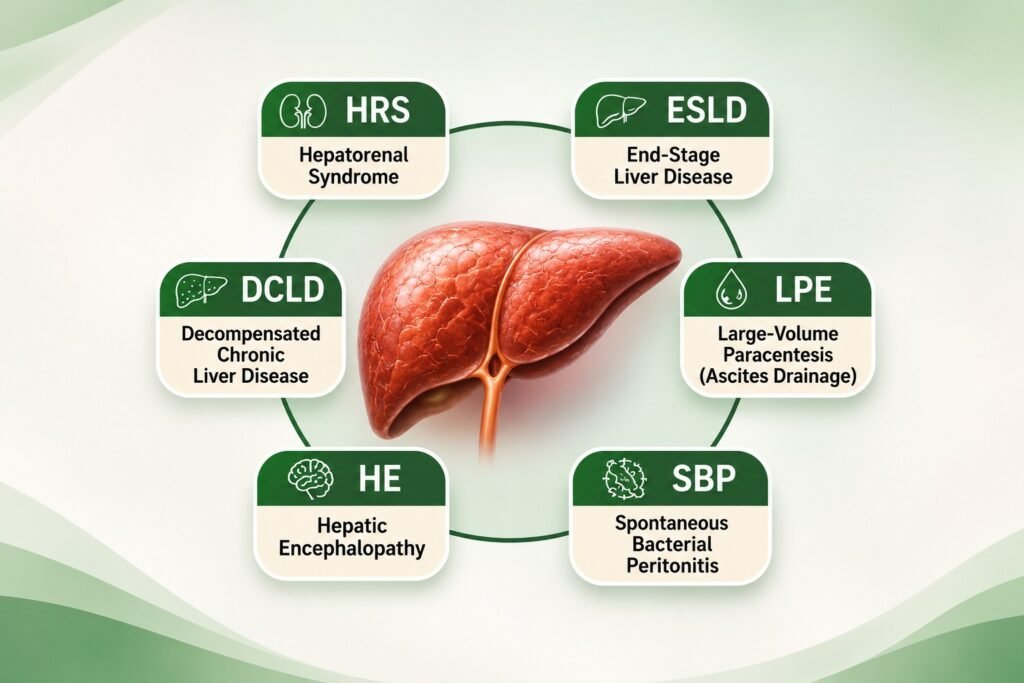
HRS is hepatorenal syndrome (kidney failure from advanced liver disease). ESLD is end-stage liver disease. DCLD is decompensated chronic liver disease. HE is hepatic encephalopathy (confusion from liver failure). SBP is spontaneous bacterial peritonitis (infected abdominal fluid). LPE varies by hospital; confirm it with your doctor.
Liver reports and discharge summaries are full of shorthand. Understanding these liver disease abbreviations helps patients and families follow the diagnosis, ask better questions and recognise warning signs early. This guide explains six terms: HRS, ESLD, DCLD, LPE, HE and SBP.
What Do Common Liver Disease Abbreviations Mean?
| Abbreviation | Full Form | Basic Meaning |
| HRS | Hepatorenal Syndrome | Kidney function declines due to severe liver disease |
| ESLD | End-Stage Liver Disease | Irreversible, advanced liver damage |
| DCLD | Decompensated Chronic Liver Disease | Chronic liver disease with complications such as ascites or jaundice |
| LPE | Liver Paired Exchange | A transplant arrangement in which incompatible donor-recipient pairs exchange living donors |
| HE | Hepatic Encephalopathy | Brain dysfunction caused by liver failure |
| SBP | Spontaneous Bacterial Peritonitis | Infection of ascitic fluid without an obvious source |
Understanding Each Abbreviation
HRS: Hepatorenal Syndrome
What it is: Kidney failure in advanced cirrhosis, even though the kidneys are structurally normal.
Types: HRS-AKI (rapid onset) and HRS-NAKI (gradual). Older texts call these Type 1 and Type 2.
Symptoms: Reduced urine output, fluid retention, fatigue and confusion.
Diagnosis: Rising creatinine in a cirrhosis patient after other causes are excluded and albumin is given.
Treatment: Vasoconstrictors such as terlipressin with albumin. Liver transplant is the definitive cure.
ESLD: End-Stage Liver Disease
What it is: The final stage of chronic liver disease, when the liver can no longer meet the body’s needs.
Signs: Jaundice, ascites, bleeding, muscle wasting, confusion and recurrent infections.
Severity: Assessed with MELD and Child-Pugh scores.
Transplant: Evaluated when complications or high scores signal limited survival without one.
DCLD: Decompensated Chronic Liver Disease
Compensated vs decompensated cirrhosis: In compensated cirrhosis, the liver is scarred but symptoms are minimal. Decompensation begins when complications appear: ascites, variceal bleeding, HE or jaundice.
Management: Treating the cause (alcohol, hepatitis, fatty liver), diuretics, salt restriction, infection prevention and transplant assessment. See liver cirrhosis treatment.
LPE: Liver Paired Exchange
What it is: Liver Paired Exchange (LPE), also called swap liver transplantation, is a living-donor liver transplant arrangement that helps overcome incompatibility between an intended donor and recipient.
Why it is needed: A willing donor may be unsuitable for their intended recipient because of:
- ABO blood group incompatibility.
- Liver graft size or volume mismatch.
- Other donor-recipient compatibility considerations.
How it works:
- Two or more donor-recipient pairs are identified.
- Donor A donates a suitable portion of their liver to Recipient B.
- Donor B donates a suitable portion to Recipient A.
- Exchanges may involve two-way swaps or more complex donor chains.
Benefits:
- Creates additional living-donor transplant opportunities.
- Helps overcome certain donor-recipient incompatibilities.
- May avoid the need for ABO-incompatible transplantation in appropriately matched pairs.
- Can expand access to living-donor transplantation.
Important consideration: Both donors and recipients must undergo comprehensive medical, anatomical and compatibility assessments. Paired exchange does not guarantee transplant eligibility or eliminate surgical risks.
HE: Hepatic Encephalopathy
Causes: Toxins such as ammonia build up when a damaged liver cannot clear them. Triggers include infection, constipation, bleeding, dehydration and certain medicines.
Symptoms: Forgetfulness, sleep reversal, personality change, confusion, drowsiness and coma.
Grading: West Haven grades 1 to 4.
Diagnosis: Clinical assessment after excluding other causes of confusion.
Treatment: Lactulose, rifaximin and treatment of the trigger.
SBP: Spontaneous Bacterial Peritonitis
What it is: Bacterial infection of ascitic fluid.
Risk factors: Ascites, low-protein ascitic fluid, prior SBP and gastrointestinal bleeding.
Symptoms: Fever, abdominal pain or tenderness, worsening ascites and confusion. Some patients have few symptoms.
Diagnosis: Paracentesis showing 250 or more neutrophils per mm³.
Treatment: Intravenous antibiotics and albumin, then preventive antibiotics in high-risk patients.
How Are These Conditions Connected?
Chronic liver disease leads to cirrhosis. As scarring progresses, portal hypertension develops and the patient moves from compensated to decompensated cirrhosis (DCLD). Complications such as ascites, HE, SBP and HRS then emerge, and together they define ESLD. A sudden worsening, often triggered by infection or alcohol, can cause acute-on-chronic liver failure (ACLF), which involves organ failure and high short-term mortality.
Sources
- AASLD – Diagnosis and Management of Ascites, Spontaneous Bacterial Peritonitis and Hepatorenal Syndrome (2021)
- ADQI and ICA – Acute Kidney Injury in Patients with Cirrhosis (2024)
- EASL – Clinical Practice Guidelines for Decompensated Cirrhosis (2018)
- EASL – Clinical Practice Guidelines on Hepatic Encephalopathy (2022)
- EASL – Clinical Practice Guidelines on Acute-on-Chronic Liver Failure (2023)
- Kim et al. – MELD 3.0: The Model for End-Stage Liver Disease Updated for the Modern Era (2021)

 WhatsApp