
Liver Transplant in Patna
Liver transplant surgery is now available in Patna at Paras Hospital, giving patients across Bihar access to structured, high-volume transplant care without travelling to Delhi or Mumbai. The transplant programme at Paras Hospital, Patna covers living donor, deceased donor, and paediatric transplants, backed by a dedicated transplant ICU, modular operation theatres, and a multidisciplinary team led by Dr. Ankur Garg.
Expert Liver Transplant Services in Patna
Paras Hospital, Patna offers comprehensive liver transplant surgery in Patna for adults and children, treating conditions including end-stage liver disease, liver cirrhosis, acute liver failure, and liver cancer. The programme follows international transplant protocols with dedicated ICU care, 24/7 emergency support, and long-term hepatology follow-up under Dr. Ankur Garg’s HPB surgical team.
Paras Hospital, Patna is a 350-bed, NABH-accredited multispecialty hospital established in 2013, located at NH 30, Bailey Road, Indrapuri, Patna. The Liver Transplant and HPB department operates as a centre of excellence for liver disease treatment in Patna, treating patients from across Bihar and neighbouring states.
Dr. Ankur Garg, Group Director of Liver Transplant and HPB Surgery at Paras Health, brings 25+ years of surgical experience and 4,500+ liver transplants and major HPB procedures. Dr. Vaibhaw Kumar, Director of Liver Transplant and GI Surgery, brings 15+ years of experience and 2,000+ transplant cases, specialising in living donor and paediatric liver transplants.
Every transplant case at this centre is reviewed by a multidisciplinary board of hepatologists, transplant surgeons, intensivists, radiologists, anaesthesiologists, and nutrition specialists before surgery. This approach is standard at high-volume transplant programmes globally and is applied consistently at the Patna centre.
When Is a Liver Transplant Needed?
A liver transplant is needed when the liver has failed or is failing to the point where medical treatment alone cannot sustain life. The most common reasons include advanced liver cirrhosis, acute liver failure, end-stage liver disease, and selected cases of liver cancer. A specialist uses the MELD score and clinical signs to decide when a transplant is the right next step.
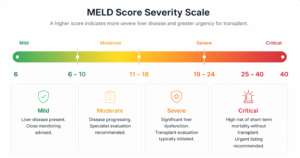
The MELD score (Model for End-Stage Liver Disease) is a number calculated from blood test results. It measures how urgently a patient needs a transplant. A MELD score above 15 generally signals that transplant evaluation should begin.
Conditions that most commonly lead to a liver transplant include:
- Liver cirrhosis from hepatitis B, hepatitis C, alcohol-related liver disease, or fatty liver disease (NAFLD/NASH)
- Acute liver failure, a rapid loss of liver function that can occur within days or weeks
- Hepatocellular carcinoma (HCC), liver cancer that meets Milan criteria for transplant eligibility
- Biliary atresia in infants, where bile ducts are absent or blocked
- Autoimmune liver diseases such as primary biliary cholangitis (PBC) or primary sclerosing cholangitis (PSC)
- Hereditary liver conditions such as Wilson’s disease or alpha-1 antitrypsin deficiency
If a family member has been diagnosed with liver cirrhosis or acute liver failure and you are unsure whether a transplant is needed, an early specialist opinion can prevent the situation from progressing to a point where surgery becomes significantly riskier.
Reach Out for Expert Care
Types of Liver Transplant Available in Patna
Paras Hospital, Patna performs living donor liver transplants (LDLT), deceased donor liver transplants (DDLT), and paediatric liver transplants, including ABO-incompatible and SWAP transplants in selected cases. The right type depends on donor availability, urgency, and the patient’s clinical condition.
Living Donor Liver Transplant (LDLT)
In a living donor liver transplant, a healthy family member donates a portion of their liver. The donor’s liver typically regenerates to near full size within 6-8 weeks. This is the most common type performed in India because deceased donor availability remains limited.
Deceased Donor Liver Transplant (DDLT)
A deceased donor transplant uses a liver from a brain-dead donor, allocated through NOTTO (National Organ and Tissue Transplant Organisation). Patients are listed on the transplant waitlist and matched based on blood type, urgency, and waiting time.
Paediatric Liver Transplant
Paediatric liver transplants are performed for children with biliary atresia, metabolic liver diseases, and acute liver failure. These cases require specialised surgical planning given the size differences involved, and are reviewed by the full transplant board before surgery.
ABO-Incompatible and SWAP Transplants
In cases where a family member is willing but blood group incompatible, ABO-incompatible liver transplant protocols allow the surgery to proceed with additional immunological preparation. SWAP liver transplants are an option when two families have compatible but internally mismatched donors.
Liver Transplant Procedure
A liver transplant in Patna follows a structured process. The key stages are transplant evaluation, listing or donor workup, surgery, ICU recovery, and post-transplant care with immunosuppressant medicines.
Stage 1: Transplant Evaluation
Before any surgery is planned, the patient undergoes a full pre-transplant workup. This includes:
- Blood tests including liver function panel and MELD score calculation
- CT or MRI imaging of the liver and blood vessels
- Cardiac evaluation (ECG, echocardiogram)
- Pulmonary function assessment
- Nutritional and psychological evaluation
- Tumour board review for liver cancer cases
In living donor cases, the donor evaluation runs parallel to the recipient’s workup and includes blood tests, CT volumetry to assess liver size, and medical and psychological fitness assessment.
Stage 2: Surgery
The recipient surgery involves removing the diseased liver and placing the donor liver, reconnecting the hepatic artery, portal vein, hepatic veins, and bile duct. Donor surgery for living donor cases is performed simultaneously in a separate theatre by a second surgical team.
Surgery typically lasts 6-12 hours for the recipient and 4-6 hours for the living donor.
Stage 3: ICU and Ward Recovery
After surgery, patients are monitored in the transplant ICU, typically for 5-10 days. Monitoring includes liver function, bleeding risk, bile output, kidney function, and infection markers. Ward stay follows, usually 10-15 days depending on recovery.
Stage 4: Post-Transplant Care
After discharge, patients take immunosuppressant medicines to prevent the body from rejecting the new liver. These medications are taken lifelong and are adjusted over time. Follow-up appointments are more frequent in the first three months, then gradually space out.
Full details on recovery timelines and costs are available through the liver transplant cost in India page or through a direct consultation.
Why Choose Paras Hospital, Patna for Liver Transplant?
Paras Hospital, Patna is one of Bihar’s leading liver transplant centres, offering a dedicated transplant ICU, NABH accreditation, a full multidisciplinary HPB team, and surgical leadership from Dr. Ankur Garg, who has performed 4,500+ transplants with a 95% success rate over 25+ years.
Key reasons patients from Bihar choose this centre:
- Experienced transplant surgeons: Dr. Ankur Garg and Dr. Vaibhaw Kumar lead a team with combined experience of 6,500+ liver transplants and HPB surgeries
- Dedicated liver transplant ICU: 24/7 multi-parameter monitoring with transplant-trained critical care specialists
- NABH-accredited facility: Infection control systems, modular operation theatres, and a NABL-accredited laboratory for accurate diagnostics
- Full-spectrum liver care: Transplant, hepatectomy, ablation therapy, robotic liver surgery, and minimally invasive surgery all available at the same centre
Liver Transplant Cost in Patna
Liver transplant cost in Patna typically ranges from ₹18 lakh to ₹25 lakh for a living donor transplant, depending on case complexity, ICU duration, and pre-operative workup. Deceased donor transplants may vary based on organ retrieval logistics. This is significantly lower than costs in Delhi, Mumbai, or abroad, with comparable outcomes.
| Component | Estimated Cost (INR) |
| Surgical team fee (recipient + donor) | ₹4,00,000 – ₹6,00,000 |
| Operation theatre and anaesthesia | ₹2,00,000 – ₹3,50,000 |
| ICU stay (5-10 days) | ₹3,00,000 – ₹5,00,000 |
| Ward stay (10-15 days) | ₹1,50,000 – ₹3,00,000 |
| Investigations and diagnostics | ₹1,00,000 – ₹2,00,000 |
| Medications and immunosuppressants | ₹1,50,000 – ₹3,00,000 |
These are estimated ranges only A detailed personalised estimate is provided after the transplant evaluation, once the clinical picture is clear.
For a complete breakdown of what is and is not included in transplant packages, refer to the liver transplant cost guide.
Insurance coverage, EMI options, and Ayushman Bharat eligibility can be confirmed with the hospital’s financial counsellors at the time of consultation.
Recovery After Liver Transplant in Patna
Liver transplant recovery involves a hospital stay of 2-4 weeks, followed by close outpatient monitoring for 3-6 months. Most patients can resume light daily activity within 4-6 weeks. Full recovery, including return to work, typically takes 3-6 months, depending on how well the new liver functions and overall health at the time of surgery.
Week 1-2: ICU monitoring. The transplant team tracks liver enzyme levels, bile output, kidney function, and signs of rejection or infection.
Week 3-4: Ward stay. Oral diet started and gradually advanced. Immunosuppressant medicines adjusted. Physiotherapy to rebuild strength.
After discharge (Month 1-3): Frequent outpatient visits for blood tests and imaging. Close monitoring for rejection episodes, which are most likely in this period. Any fever, yellowing of skin, or abdominal pain should be reported immediately.
Month 3-6: Follow-up appointments begin to space out. Most patients feel significantly better. Dietary guidance and lifestyle adjustments continue.
6 months onwards: Many patients return to normal daily activity, including work, exercise, and travel. Lifelong immunosuppressant medicines continue, and annual cancer screening is recommended given the slightly elevated risk from long-term immunosuppression.
Patients from Muzaffarpur, Gaya, Bhagalpur, and other parts of Bihar may find it practical to arrange accommodation near the hospital during the first 3 months of follow-up rather than making frequent long-distance trips. The team can assist with guidance on this. Read more about planning liver transplant care from across Bihar.
Risks and Success Rate of Liver Transplant in Patna
The liver transplant success rate in India at leading centres is 85-90% at one year, which is comparable to the best transplant programmes globally. At Paras Health, the overall success rate across the transplant programme is 95%. Like any major surgery, a liver transplant carries some risks:
Common risks associated with liver transplant surgery include:
- Rejection: The immune system may attack the new liver. This is managed with immunosuppressant medicines and is most common in the first year.
- Infection: Immunosuppression reduces the body’s ability to fight infection. Prophylactic medications and close monitoring manage this risk.
- Bleeding and bile leak: Both are monitored closely in the ICU immediately after surgery.
- Primary non-function: Rare, but the donor liver may not work adequately after transplant, requiring re-evaluation.
- Vascular complications: Issues with the hepatic artery or portal vein connections, detected early through imaging.
At high-volume centres, the risk of serious complications is considerably lower than at low-volume facilities. This is one of the strongest reasons to choose a centre where the team performs a substantial number of transplants each year rather than a handful.
For a detailed discussion of long-term survival data and what affects outcomes, read the liver transplant success rate guide.
Reach Out for Expert Care
Patients We Serve Across Bihar and Nearby Regions
The liver transplant centre at Paras Hospital, Patna serves patients from across Bihar and neighbouring regions, providing advanced hepatology and transplant care without the need to travel to Delhi or other major metros.
Patients regularly travel from:
- Muzaffarpur, Darbhanga, Sitamarhi, Motihari, Bettiah (North Bihar)
- Gaya, Ara, Aurangabad, Nawada (South Bihar)
- Bhagalpur, Munger, Begusarai, Samastipur, Khagaria (East Bihar)
- Purnia, Katihar, Kishanganj (Southeast Bihar)
- Bihar Sharif, Nalanda, Rajgir (Central Bihar)
- Hajipur, Chapra, Siwan, Saran (West Bihar)
- Jharkhand, including Ranchi, Dhanbad, and Jamshedpur
- Eastern Uttar Pradesh, including Varanasi, Gorakhpur, and Ballia
Patna is reachable from most of these locations within 2-6 hours by road or rail, making it a practical base for transplant evaluation, surgery, and follow-up care. For patients coming from Nepal or Jharkhand, the team provides coordination support for documentation and accommodation planning.
What Matters Most
A liver transplant is one of the most important decisions a family will make. The right centre, the right team, and early evaluation make a measurable difference to outcomes. If you have been searching for the best liver transplant hospitals in Patna or have been told a transplant may be needed, the best next step is a specialist opinion before the condition progresses further.
FAQs
Senior liver specialist with extensive experience in transplant and complex liver care.
Is liver transplant available in Patna? expand_more
Yes. Paras Hospital, Patna has a dedicated liver transplant department performing living donor, deceased donor, and paediatric transplants, backed by a full multidisciplinary HPB team and transplant ICU.
What MELD score is needed for a liver transplant? expand_more
A MELD score above 15 generally triggers transplant evaluation. Scores above 25-30 indicate significant urgency.
Can liver cancer be treated with a liver transplant? expand_more
Yes, in selected cases. Patients with hepatocellular carcinoma (HCC) that meets Milan criteria, may be eligible for a liver transplant as part of their cancer treatment.
Can patients from Muzaffarpur or Gaya come to Patna for a liver transplant? expand_more
Yes. Most patients from across Bihar choose Patna over travelling to Delhi or Mumbai.
Who is the best liver transplant surgeon in Patna? expand_more
Dr. Ankur Garg is among the most trusted names in liver transplant surgery in India. Dr. Garg brings 25+ years of experience and 4,500+ transplants.

Dr. Ankur Garg's Medical Content Team
Dr. Ankur Garg’s medical content team specialises in creating accurate, clear, and patient-focused healthcare content. With strong clinical understanding and expertise in technical writing and SEO, the team translates complex medical information into reliable, accessible resources that support informed decisions and uphold Dr. Ankur Garg’s commitment to quality care.

 WhatsApp