
Who Can Be a Living Liver Donor? Eligibility, Tests and Recovery

When a family member is advised of a liver transplant, the first question is often: “Can I donate?”
A living donor liver transplant in India is the most common route for patients with end-stage liver disease or liver cirrhosis. It does not depend on a waiting list. It can be planned, but before anything else, the donor needs to be evaluated properly.
Here is everything a potential liver donor and their family need to know.
Who Can Be a Living Liver Donor?
A living liver donor is a healthy adult who voluntarily donates a portion of their liver to a patient in need of a liver transplant. The donated liver portion regenerates over time in both donor and recipient.
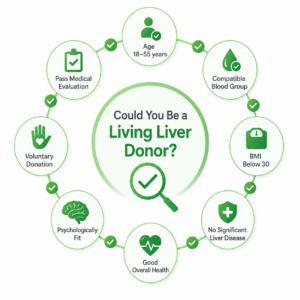
Living liver donor criteria in India are set under the THOTA (Transplantation of Human Organs and Tissues Act). The basic requirements are:
- Age 18 to 55 years
- Blood group compatible with the recipient
- BMI below 30
- No active liver disease, cancer, uncontrolled diabetes, or heart condition
- No history of alcohol abuse
- Adequate liver volume to donate safely
- Willingness to donate without any pressure or financial motive
If blood group compatibility is not there, an ABO-incompatible liver transplant is an option in select cases. Dr. Ankur Garg performs this at LivCure.
What Tests Are Done Before Liver Donation?
The living liver donor evaluation takes about one to two weeks. No surgery is planned until all tests are clear.
- Blood group and cross-match – first and most basic step
- Liver function tests and blood count – checks if the donor’s liver is healthy
- Kidney function and urine tests – ensure the kidneys can handle major surgery
- Infection screening – hepatitis B, hepatitis C, HIV, CMV, EBV
- Coagulation profile – checks blood clotting ability
- CT volumetry – measures exact liver size and how much can safely be removed
- MRI or MRCP – maps bile ducts and blood vessels for surgical planning
- Echo and lung function tests – confirms heart and lungs are fit for anaesthesia
- Psychological evaluation – confirms voluntary, informed consent
Documents required typically include proof of identity and medical test reports. The LivCure transplant coordinator guides families through the full checklist.
What Happens During the Living Donor Liver Transplant Procedure?
In a living donor liver transplant procedure, the surgeon removes either the right lobe (about 60 to 70 per cent of the liver) for adult recipients, or the left lobe for paediatric cases.
Both donor and recipient surgeries are performed simultaneously by separate teams. The procedure takes six to eight hours under general anaesthesia.
For paediatric cases, read more: Paediatric Liver Transplant at LivCure
What Does Living Donor Liver Transplant Recovery Look Like?
| Phase | What to Expect |
| Week 1 | Hospital stay of 7 to 10 days. ICU for first 1 to 2 days, then shifted to the ward |
| Weeks 2 to 4 | Rest at home. Light movement encouraged. No lifting or exertion |
| Month 1 to 2 | Most donors return to desk work. Liver actively regenerating |
| Month 2 to 3 | Near-full recovery. Liver returns to close to original size |
Long-term quality of life for living liver donors is generally very good. Most donors have near normal liver function within three months.
What Are the Risks and Complications of Living Liver Donation?
Living donor liver transplant is major surgery. Risks exist and should be understood honestly.
- Bile leak – most common complication among living liver donor complications, usually manageable without major intervention
- Bleeding and infection – standard surgical risks, monitored closely post-op
- Blood clots or hernia – less common, addressed during follow-up
- Anaesthesia reactions – rare but possible
Live liver donor mortality risk is very low, estimated at 0.1 to 0.5 per cent globally. This figure is lower at high-volume centres with structured donor safety protocols.
At LivCure, no donor is approved under pressure. If any test raises a concern, surgery does not proceed. Dr. Ankur Garg’s programme at Paras Health Gurugram maintains a 95 percent overall transplant success rate across more than 4,500 liver transplant cases.
Schedule a Living Liver Donor Evaluation in India
If you are considering donating a portion of your liver to a loved one, the first step is a comprehensive living liver donor evaluation.
At LivCure, Paras Health Gurugram, every potential donor undergoes a structured assessment to ensure donation can be performed safely for both the donor and recipient. The evaluation is conducted by a multidisciplinary transplant team that includes a liver transplant surgeon, hepatologist, anaesthesiologist, psychologist, and transplant coordinator.
The assessment typically includes blood group matching, liver function testing, imaging studies, medical fitness checks, and psychological evaluation to confirm donor suitability.

 WhatsApp