
Fatty Liver (MASLD): How It Can Progress to Cirrhosis and Liver Transplant
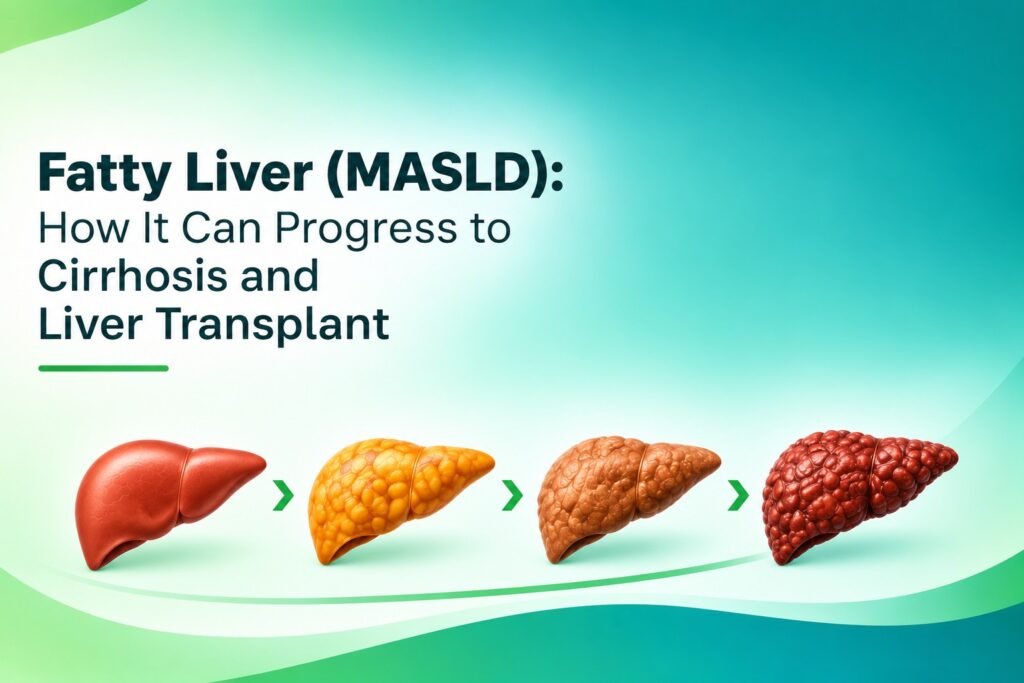
Can a condition as common as fatty liver eventually lead to liver failure? For a small proportion of people, yes. But for most, it never gets that far.
Fatty liver is often silent in its early stages, which is why it goes unnoticed for years. It is now called MASLD (Metabolic Dysfunction-Associated Steatotic Liver Disease), a name that replaces the older term NAFLD and links the condition to metabolic health. When fat in the liver is joined by inflammation, it can lead to scarring (fibrosis) and, in some people, cirrhosis.
Progression is not inevitable, and early action can lower the risk of complications.
Quick answer: Can fatty liver lead to cirrhosis? Yes, fatty liver (MASLD) can progress to MASH, liver fibrosis and eventually cirrhosis in some individuals. However, progression is not inevitable. Early diagnosis, weight management, control of metabolic conditions and regular liver assessments can help reduce the risk of advanced liver damage.
What Is Fatty Liver Disease (MASLD)?
MASLD is a condition in which excess fat builds up in liver cells in people who have metabolic risk factors. In everyday language, it is the same thing most people call fatty liver.
A more active form is MASH (Metabolic Dysfunction-Associated Steatohepatitis), formerly called NASH. Here, fat is accompanied by inflammation and liver-cell injury, and this is the form most likely to cause scarring.
Common risk factors include obesity, type 2 diabetes, insulin resistance, high cholesterol, high blood pressure and metabolic syndrome. MASLD can also occur in people who do not look overweight, particularly in India, where metabolic risk can be present at a lower body weight. It is different from alcohol-related liver disease, although the two can coexist.
Request a Consultation
How Does Fatty Liver Progress to Cirrhosis?
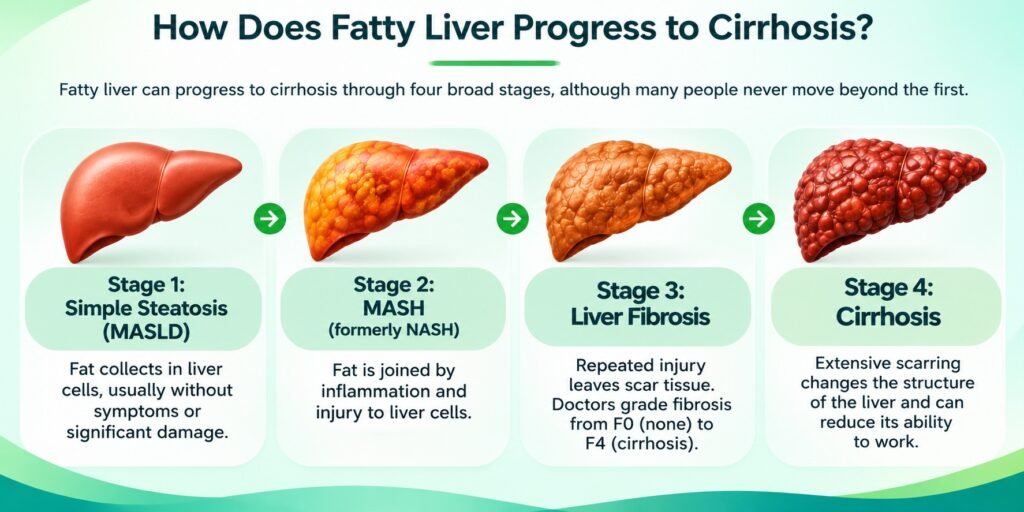
Fatty liver can progress to cirrhosis through four broad stages, although many people never move beyond the first.
- Stage 1: Simple steatosis (MASLD). Fat collects in liver cells, usually without symptoms or significant damage.
- Stage 2: MASH (formerly NASH). Fat is joined by inflammation and injury to liver cells.
- Stage 3: Liver fibrosis. Repeated injury leaves scar tissue. Doctors grade fibrosis from F0 (none) to F4 (cirrhosis).
- Stage 4: Cirrhosis. Extensive scarring changes the structure of the liver and can reduce its ability to work.
Not everyone passes through every stage. Advanced fibrosis and cirrhosis can develop without obvious symptoms, which is why they are often found late.
Early cirrhosis is called compensated, meaning the liver is still coping. Later it can become decompensated, when complications appear: raised pressure in the liver’s blood vessels (portal hypertension), fluid in the abdomen (ascites), bleeding from swollen veins in the food pipe (variceal bleeding) and a higher risk of liver cancer.
There is no fixed timeline for this. Some people stay stable for years, while others progress faster.
What Are the Warning Signs That Fatty Liver Is Getting Worse?
Symptoms alone cannot tell you how advanced the disease is, but they follow a general pattern:
- Early MASLD: usually no symptoms, sometimes tiredness or a vague ache in the upper right abdomen.
- Advanced fibrosis: often still no symptoms.
- Cirrhosis: yellowing of the eyes and skin (jaundice), swelling of the abdomen or legs, easy bruising, muscle loss and persistent fatigue.
- Advanced complications: confusion, vomiting blood or black stools.
Seek urgent medical care if you vomit blood, pass black stools, become newly confused or have severe abdominal symptoms.
How Is MASLD Diagnosed Before It Reaches Cirrhosis?
Because early disease is silent, doctors look for it in people with risk factors. Assessment usually includes:
- Medical history: diabetes, obesity, alcohol intake and other metabolic risks.
- Liver function tests: ALT, AST, bilirubin and related markers (how to read an LFT report).
- Ultrasound: to detect fat in the liver.
- FIB-4 score: a simple calculation using age, AST, ALT and platelet count to estimate the risk of advanced fibrosis.
- FibroScan (transient elastography): a painless scan that measures liver stiffness to estimate scarring.
- MRI-based assessment or liver biopsy: when more detail is clinically needed.
An important point: normal liver enzymes do not rule out advanced fibrosis, and ultrasound or blood tests alone are not enough to judge how healthy the liver is.
Can Fatty Liver Be Reversed? Treatment Options Before Cirrhosis
Early fatty liver can often improve, and some degrees of fibrosis may improve too. Treatment focuses on the following:
- Gradual, sustained weight loss.
- Regular physical activity and a balanced diet.
- Good control of diabetes, cholesterol and blood pressure.
- Management of other metabolic risk factors.
- Specialist-guided medicines for eligible patients with MASH and significant fibrosis, where approved and appropriate.
- Regular follow-up to monitor liver health.
Once advanced fibrosis or cirrhosis develops, the approach shifts to specialist liver cirrhosis treatment. Established cirrhosis may not fully reverse, but treatment can still slow further damage and reduce complications.
When Does Fatty Liver-Related Cirrhosis Require a Liver Transplant?
Not everyone with cirrhosis needs a transplant. Many people live for years with compensated cirrhosis under regular care. A transplant becomes a consideration when the liver can no longer perform its essential functions.
Signs that the disease has advanced include recurrent ascites, hepatic encephalopathy (confusion caused by the liver’s failure to clear toxins), variceal bleeding and worsening liver function. At that point, doctors consider a liver transplant evaluation.
The decision depends on your overall health, the complications you have, your MELD score (a blood-test-based measure of how severe liver disease is) and a specialist’s assessment.
If advanced disease is suspected, evaluation by an experienced liver transplant surgeon such as Dr. Ankur Garg helps clarify whether transplantation is needed, whether other treatments may be enough, and when to act.
What Should Patients Know About Liver Transplant in India?
Families often have practical questions, and it helps to know the basics:
- Living donor or deceased donor: a transplant may use part of a liver from a healthy living donor or a liver from a deceased donor, depending on suitability.
- Evaluation: this includes tests of the patient’s health and, for living donation, donor compatibility.
- Team approach: a multidisciplinary transplant team reviews each case.
- After transplant: lifelong immunosuppressive medicines and regular monitoring are needed.
- Metabolic health: the risk factors behind MASLD can persist after transplant, so diabetes, weight and cholesterol need continued care.
Choosing a centre with the right transplant infrastructure and long-term follow-up matters. A specialist such as Dr. Ankur Garg can help you understand whether you are a suitable candidate and how to prepare for surgery and recovery. To understand what goes into the expense, see liver transplant cost in India.
How Can You Prevent Fatty Liver From Progressing to Cirrhosis?
- Maintain a healthy weight and exercise regularly.
- Keep diabetes, cholesterol and blood pressure under control.
- Follow a balanced diet you can sustain.
- Avoid alcohol, especially if you already have liver disease.
- Get checked if you have metabolic risk factors or a past fatty liver diagnosis.
- Follow recommended liver monitoring instead of waiting for symptoms.
Early diagnosis and steady management make a meaningful difference.
Final Takeaway
MASLD does not automatically lead to cirrhosis or a liver transplant. But ignoring metabolic risk factors and early scarring can let the disease advance. Early assessment, appropriate treatment and specialist follow-up protect long-term liver health.
If you have fatty liver, diabetes or other metabolic risks, consider a professional liver evaluation. The team at LivCure India, including Dr. Ankur Garg, can guide you on the right next step.
Sources
- Rinella et al. – A Multisociety Delphi Consensus Statement on New Fatty Liver Disease Nomenclature (Hepatology, 2023)
- Rinella et al. – AASLD Practice Guidance on the Clinical Assessment and Management of
- Nonalcoholic Fatty Liver Disease (Hepatology, 2023)
- EASL–EASD–EASO – Clinical Practice Guidelines on the Management of MASLD (2024)
- Martin et al. – Evaluation for Liver Transplantation in Adults: AASLD and American Society of Transplantation Practice Guideline (2014)

 WhatsApp