
What Is a MELD Score? Everything You Need to Know
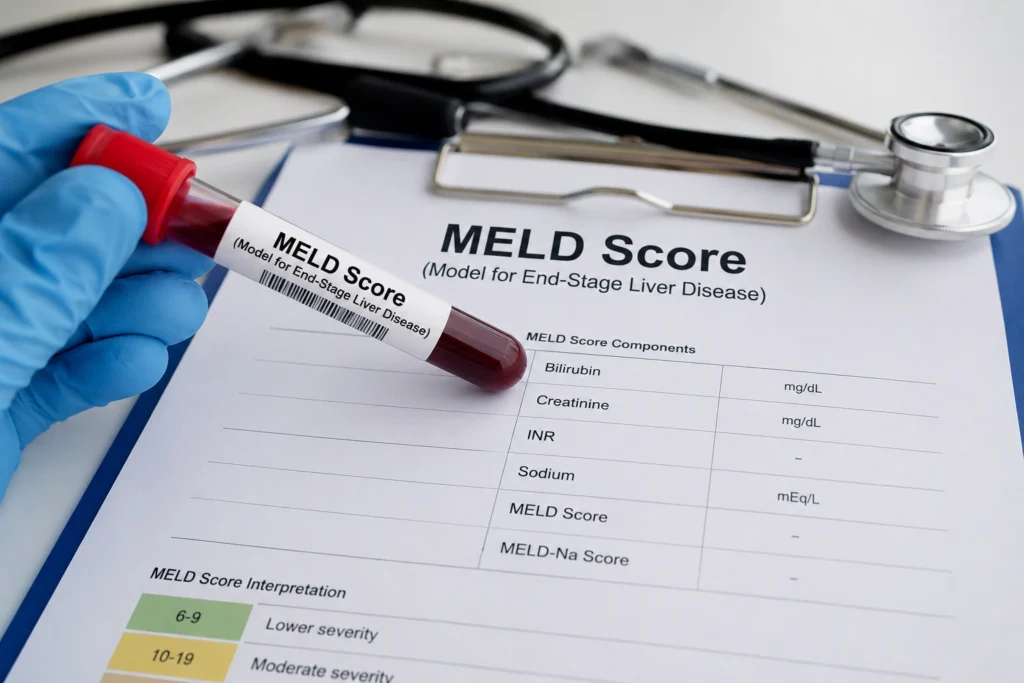
A MELD score (Model for End-Stage Liver Disease score) is a medical scoring system used to measure the severity of chronic liver disease and determine a patient’s priority for a liver transplant. It is calculated using blood test results, including bilirubin, creatinine, INR, and sodium (MELD-Na score). A higher MELD score indicates more severe liver disease and a greater need for liver transplantation.
Introduction
Living with advanced liver disease can be stressful, especially when you hear unfamiliar medical terms like the MELD score. If your liver doctor has mentioned it, you may wonder what it means, how it is calculated, and whether it determines your chances of receiving a liver transplant.
The MELD score is one of the most important tools doctors use to assess liver function. It helps estimate how severely the liver is affected and identifies patients who may need a liver transplant sooner than others.
Understanding your MELD score can help you make informed decisions about your treatment, follow-up care, and transplant planning. In this guide, we’ll explain what a MELD score is, how to calculate the MELD score, the MELD score components, what the numbers mean, and whether a MELD score can decrease over time.
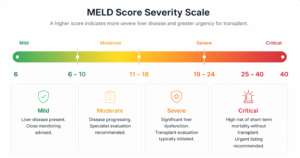
What Does MELD Stand For?
MELD stands for Model for End-Stage Liver Disease.
It was originally developed to predict the risk of death in patients with severe liver disease. Today, it is widely used worldwide to determine liver transplant priority.
Instead of relying on symptoms alone, doctors use the MELD score because it provides an objective assessment based on laboratory test results.
Why Is the MELD Score Important?
The liver performs multiple functions, including removing toxins, producing proteins, storing nutrients, and helping with digestion. When liver function declines, the risk of complications increases.
The MELD score helps doctors:
- Measure the severity of liver disease
- Estimate the risk of liver failure
- Determine liver transplant eligibility
- Prioritise patients on the transplant waiting list
- Monitor disease progression over time
As donor livers are limited, the MELD score helps ensure that organs are allocated to patients with the greatest medical need.
Who Needs a MELD Score?
A doctor may recommend a MELD score for people with advanced liver disease, including:
- Liver cirrhosis
- Chronic liver failure
- Hepatitis-related liver damage
- Alcohol-related liver disease
- Fatty liver disease with cirrhosis
- Certain liver cancers being evaluated for transplantation
Patients being considered for a liver transplant usually have their MELD score checked regularly because it can change as their condition changes.
How Is the MELD Score Calculated?
One of the most common questions patients ask is, “How to calculate the MELD score?”
Doctors use a mathematical formula based on specific blood test results. The standard calculation includes:
| MELD Score Components | What It Measures |
| Bilirubin | How effectively the liver removes bile pigments |
| Creatinine | Kidney function, which often declines in advanced liver disease |
| INR (International Normalised Ratio) | The liver’s ability to produce blood-clotting proteins |
| Sodium (MELD-Na Score) | Helps improve prediction of survival in patients with advanced liver disease |
Many hospitals use the MELD-Na score, which includes sodium levels because low sodium is associated with poorer outcomes.
Although many websites offer a MELD score calculator, the results should always be interpreted by a liver specialist.
MELD Score Monitoring
The frequency of MELD score testing depends on the severity of your liver disease and whether you are on the liver transplant waiting list. Since the score is based on blood test results, it can change over time as your condition improves or worsens.
In general:
| Patient’s Condition | Typical Monitoring Frequency |
|---|---|
| Stable liver disease with a low MELD score | Every 3-6 months or as advised |
| Moderate liver disease | Every 1-3 months |
| High MELD score or awaiting liver transplant | Every few weeks or as required by the transplant centre |
Your liver specialist may recommend more frequent testing if you develop complications such as infections, kidney problems, gastrointestinal bleeding, or worsening liver function. Regular monitoring helps ensure your MELD score accurately reflects your current health and allows your treatment or transplant priority to be updated when necessary.
Why MELD Scores Can Change Over Time
Another frequently searched question is, “Does MELD score fluctuate?”
Yes.
The MELD score is calculated using laboratory values, and these can change over time depending on:
- Progression of liver disease
- Kidney function
- Bleeding episodes
- Infections
- Medications
- Dehydration
Because of these changes, patients waiting for a liver transplant often undergo repeat blood tests to keep their MELD score updated.
Improving a MELD Score
A MELD score can improve in some cases if the underlying cause of liver dysfunction is treated effectively. For example, managing infections, controlling complications, improving kidney function, stopping alcohol consumption in alcohol-related liver disease, or receiving appropriate medical treatment may lead to better laboratory values and a lower MELD score.
However, in patients with advanced cirrhosis or end-stage liver disease, the MELD score may remain stable or continue to increase despite treatment. This is why regular follow-up and repeat blood tests are essential, particularly for patients being evaluated for a liver transplant. Any changes in the MELD score should always be interpreted by a liver specialist, as they may influence treatment decisions and transplant planning.
MELD Score vs. MELD-Na Score
You may also hear about the MELD-Na score.
The MELD-Na score is an updated version of the traditional MELD score that includes serum sodium.
Low sodium levels are associated with a higher risk of complications in patients with advanced liver disease. By including sodium, the MELD-Na score provides a more accurate estimate of disease severity and transplant priority.
Today, many transplant programs use the MELD-Na score instead of the original MELD score.
Limitations of the MELD Score
Although the MELD score is a valuable clinical tool, it does have limitations.
It does not measure:
- Quality of life
- Degree of fatigue
- Fluid accumulation
- Nutritional status
- Muscle loss
- Certain liver cancer-related factors
This is why doctors never rely solely on the MELD score. A comprehensive medical evaluation is always necessary before making treatment or transplant decisions.
Final Thoughts
The MELD score is one of the most reliable tools used to assess the severity of liver disease and determine liver transplant priority. By evaluating key laboratory values including bilirubin, creatinine, INR, and sodium in the MELD-Na score, it provides doctors with an objective way to estimate disease severity and guide treatment decisions.
While the MELD score provides valuable information, but doctors also consider many other aspects of your health. Your symptoms, overall health, imaging findings, and specialist evaluation all play a vital role in planning the most appropriate treatment.

 WhatsApp