
ABO Incompatible Liver Transplant in Gurgaon
An ABO-incompatible liver transplant in Gurgaon offers hope to patients who need a liver transplant but do not have a blood-group-matched donor. In this procedure, a patient can receive a liver from a living donor with a different blood group, using advanced desensitisation protocols, antibody reduction therapy, and careful post-transplant monitoring.
For patients with end-stage liver disease, liver cirrhosis, acute liver failure, or selected liver cancers, waiting for a compatible donor may not always be possible. In such cases, an ABO-incompatible living donor liver transplant may help expand donor options and allow timely treatment.
Dr. Ankur Garg, an experienced liver transplant and HPB surgeon in Gurgaon, provides evaluation and treatment planning for complex liver transplant procedures, including ABO incompatible liver transplant, living donor liver transplant, and advanced hepatobiliary surgery at Paras Health, Gurugram.
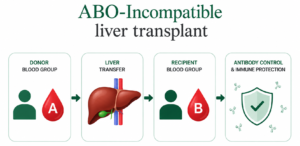
What Is an ABO Incompatible Liver Transplant?
An ABO-incompatible liver transplant is a liver transplant procedure in which the donor and recipient have different blood groups. Normally, blood group matching is preferred to reduce the risk of immune rejection. However, with modern transplant immunology, selected patients can undergo a liver transplant even when the donor’s blood group does not match.
Before surgery, the patient receives specialised treatment called desensitisation to reduce harmful antibodies that may attack the donor liver.
Reach Out for Expert Care
Why Blood Group Compatibility Matters in Liver Transplant?
The immune system protects the body by identifying foreign substances. Blood groups carry antigens, and when the donor’s blood group is different from the recipient’s, the immune system may produce antibodies against the transplanted liver.
This can increase the risk of:
- Antibody-mediated rejection
- Early graft dysfunction
- Infection due to stronger immunosuppression
- Bile duct complications
- Need for close post-transplant monitoring
However, the liver has unique immune tolerance compared to some other organs. With proper preparation, monitoring, and transplant expertise, an ABO-incompatible liver transplant can be considered for suitable patients.
When is an ABO Incompatible Liver Transplant Recommended?
Doctors may recommend an ABO-incompatible liver transplant when a patient needs transplant surgery but does not have a compatible donor.
It may be considered in cases such as:
- No blood-group-compatible donor is available
- The patient has advanced liver disease and cannot wait long
- A family member is willing to donate, but has a different blood group
- The patient has acute or rapidly progressing liver failure
- A living donor transplant is medically preferred
- The patient’s condition requires early transplant planning
This decision is made only after a detailed medical evaluation of both the recipient and the donor.
ABO Incompatible Living Donor Liver Transplant
In many cases, an ABO-incompatible liver transplant is performed as a living donor liver transplant. In this procedure, a healthy donor gives a portion of their liver to the recipient.
The liver can regenerate. After surgery, the remaining liver in the donor and the transplanted liver portion in the recipient gradually grow and adapt over time.
A living donor ABO incompatible transplant may be helpful when:
- A family donor is available, but has a different blood group
- The patient cannot wait for a deceased donor liver
- Early transplant may improve treatment planning
- Donor evaluation confirms safety and suitability
- The transplant team can follow a structured desensitisation protocol
Donor safety remains a major priority. The donor undergoes a detailed medical, surgical, psychological, and imaging evaluation before approval.
ABO Compatible vs ABO Incompatible Liver Transplant
| Factor | ABO Compatible Liver Transplant | ABO Incompatible Liver Transplant |
|---|---|---|
| Blood Group Match | Donor and recipient blood groups are compatible | Donor and recipient blood groups are different |
| Donor Availability | May be limited | Expands donor options |
| Preparation | Standard transplant workup | Additional immune preparation required |
| Desensitisation | Usually not needed | Required before transplant |
| Plasmapheresis | Usually not needed | May be used to reduce antibodies |
| Rejection Risk | Lower immunological risk | Higher risk, needs close monitoring |
| Cost | Standard liver transplant cost | May be higher due to additional protocols |
| Follow-up | Regular transplant follow-up | More intensive immune monitoring may be required |
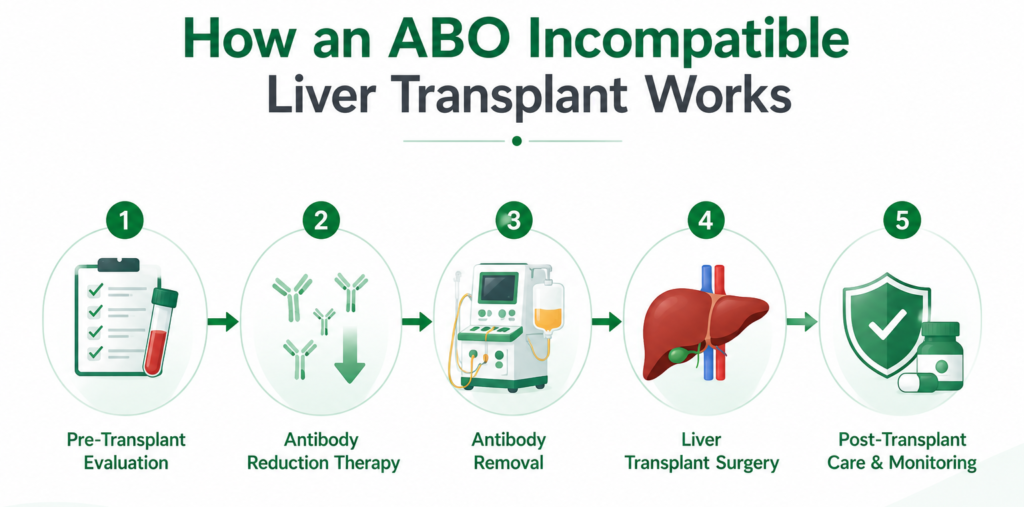
How an ABO Incompatible Liver Transplant Works?
An ABO-incompatible liver transplant is carefully planned in multiple stages to reduce the risk of rejection and help the patient’s body accept a liver from a donor with a different blood group. The process involves detailed evaluation, antibody control, transplant surgery, and close post-transplant monitoring.
1. Pre-Transplant Evaluation
The first step is to assess both the recipient and the donor to confirm whether the transplant can be performed safely. The transplant team reviews blood group details, antibody levels, liver function, donor suitability, imaging reports, infection status, and overall fitness for major surgery.
This evaluation helps the doctors understand the medical risks and prepare a personalised transplant plan.
2. Antibody Reduction Therapy
Before surgery, the patient may receive medicines to reduce the immune system’s reaction against the donor liver. This step is commonly known as desensitisation.
It may include antibody-suppressing medicines, rituximab-based therapy, immunosuppressive medicines, and regular monitoring of antibody levels. The goal is to reduce the risk of antibody-mediated rejection after transplantation.
3. Antibody Removal
In selected cases, doctors may use plasmapheresis, also known as plasma exchange, to remove harmful antibodies from the blood.
During this process, antibody-rich plasma is removed, and replacement fluids are administered. Antibody levels are checked regularly before transplant to ensure the patient is ready for surgery.
4. Liver Transplant Surgery
Once antibody levels are controlled and the patient is medically fit, the liver transplant surgery is performed. The diseased liver is removed and replaced with a healthy liver graft from the donor.
The surgical team reconnects the major blood vessels and bile duct, restores blood flow, and checks the function of the transplanted liver. The procedure is performed with ICU, anaesthesia, and multidisciplinary transplant support.
5. Post-Transplant Care & Monitoring
After surgery, the patient is closely monitored in the transplant ICU. Doctors regularly check liver function, antibody levels, blood flow to the liver, infection risk, and response to immunosuppressive medicines.
Long-term follow-up is essential because an ABO-incompatible transplant requires careful immune monitoring even after discharge.
The ABO incompatible liver transplant process usually follows five key steps: evaluation, antibody reduction, antibody removal, transplant surgery, and post-transplant monitoring.
Benefits of ABO Incompatible Liver Transplant
ABO-incompatible transplant techniques have expanded treatment options for patients who do not have a matching donor.
Key benefits include:
- Reduces waiting time for transplant
- Allows family members with different blood groups to donate
- Helps critically ill patients receive timely treatment
- Expands living donor liver transplant options
- Provides an option when compatible donors are unavailable
Many patients who previously had limited choices can now be evaluated for an ABO-incompatible liver transplant in India.
Reach Out for Expert Care
Who Is Eligible for an ABO Incompatible Liver Transplant?
Eligibility depends on several factors related to both the patient and the donor.
Doctors usually consider:
- Severity of liver disease
- Overall health of the patient
- Availability of a suitable living donor
- Absence of severe infections
- Ability to undergo major surgery
Patients undergo a detailed transplant evaluation that includes medical tests, imaging studies, and consultations with liver specialists.
Risks and Challenges of ABO Incompatible Liver Transplant
Like any major surgery, this procedure carries certain risks. However, experienced transplant teams take extensive precautions to minimise complications.
Possible risks include:
- Antibody-mediated rejection
- Increased infection risk due to immunosuppressive medications
- Bile duct complications
- Bleeding or surgical complications
To reduce these risks, patients should undergo transplantation under the supervision of an experienced team. Specialists such as Dr. Ankur Garg use desensitisation protocols, careful immunological monitoring, and multidisciplinary transplant care to improve graft survival and overall treatment success.
Recovery After ABO Incompatible Liver Transplant
Recovery happens in stages and requires close monitoring, medicines, diet support, and lifestyle changes.
Immediate Recovery: First 3–5 Days
The patient is monitored in the transplant ICU. Doctors check vital signs, liver function, antibody levels, blood flow to the graft, pain, and fluid and electrolyte levels. Doppler ultrasound may be used to assess blood circulation.
Hospital Recovery: 2–3 Weeks
During a hospital stay, regular blood tests are done to monitor liver enzymes, bilirubin, infection risk, and medication levels. Immunosuppressive medicines are adjusted, and the patient gradually starts mobilisation and physiotherapy.
Home Recovery: 2–3 Months
After discharge, patients must take medicines exactly as prescribed, avoid heavy lifting, maintain hygiene, attend follow-up visits, and avoid alcohol completely.
Long-Term Care
Periodic blood tests, imaging, and specialist follow-up are required. Many patients gradually return to normal activities within 3–6 months, depending on recovery and overall health.
Cost of ABO Incompatible Liver Transplant in Gurgaon
The average cost of an ABO-incompatible liver transplant in Gurgaon is 15 Lakhs to 25 Lakhs. It can vary depending on several factors. These include:
- Hospital infrastructure
- Experience of the transplant surgeon
- Pre-transplant treatments such as plasmapheresis
- ICU stay and hospitalisation
- Post-transplant medications and follow-up care
In ABO-incompatible liver transplants, the cost may be slightly higher in some cases due to additional immunological preparation required before surgery. Patients should consult a liver transplant specialist in Gurgaon for a personalised treatment plan and an accurate cost estimate based on their medical condition and donor availability.
ABO Incompatible Liver Transplant Success Rate in Gurgaon
With modern desensitisation protocols, rituximab-based therapy, plasmapheresis, and optimised immunosuppression, outcomes of ABO-incompatible liver transplant have improved over time.
In selected patients and experienced centers, reported survival outcomes may be approximately:
- 1-year survival: 85–90%
- 3-year survival: 80–85%
- 5-year survival: 75–80%
Success depends on the patient’s liver disease stage, antibody levels, infection status, donor health, surgical complexity, ICU care, medicine compliance, and long-term follow-up. Individual results may vary.
Why Choose Dr. Ankur Garg for ABO Incompatible Liver Transplant in Gurgaon?
Choosing the right surgeon is important for an ABO-incompatible liver transplant because the procedure requires advanced surgical expertise and specialised immune management.
Patients consult Dr. Ankur Garg for complex liver transplant procedures because of:
- 25+ years of experience in liver transplant, HPB, and gastrointestinal surgery
- Experience with 4,500+ liver transplants and major HPB procedures
- Expertise in living donor and ABO-incompatible liver transplant protocols
- Use of structured desensitisation and immunosuppression strategies
- Access to a dedicated transplant ICU and advanced surgical infrastructure
- Multidisciplinary care involving hepatologists, anaesthesiologists, intensivists, and transplant support teams
Dr. Ankur Garg performs advanced liver transplant and HPB procedures at Paras Health, Gurugram, a tertiary care centre for hepatobiliary and transplant surgery in Delhi NCR.
Take the Next Step
An ABO-incompatible liver transplant in Gurgaon may be a suitable option for patients who need a liver transplant but do not have a compatible blood group donor. With advanced desensitisation protocols, living donor transplant planning, ICU-based monitoring, and experienced surgical care, selected patients can be evaluated for this complex procedure.
If you or your loved one is exploring liver transplant options, consult Dr. Ankur Garg for detailed evaluation, eligibility review, cost guidance, and personalised treatment planning.
FAQs
Senior liver specialist with extensive experience in transplant and complex liver care.
What is the success rate of ABO incompatible liver transplant in Gurgaon? expand_more
The success rate of ABO-incompatible liver transplant in Gurgaon has improved significantly with modern desensitisation protocols. Studies report 1-year survival rates of approximately 85-90%, with outcomes approaching those of compatible liver transplants when performed in experienced centres.
Who can donate for an ABO-incompatible liver transplant? expand_more
In most cases, a living donor, usually a family member or close relative, can donate a portion of their liver, even if their blood group differs from the recipient's. Careful donor evaluation ensures the safety of both the donor and recipient.
What is the cost of ABO incompatible liver transplant in Gurgaon? expand_more
The average cost of ABO-incompatible liver transplant in Gurgaon is 18 Lakhs to 22 Lakhs. However, the exact cost depends on factors such as the type of transplant, hospital stay, and post-transplant care.
How long does recovery take after a liver transplant? expand_more
Most patients stay in the hospital for about 2-3 weeks after surgery. Full recovery and gradual return to normal activities typically occur within 2-3 months, with regular follow-up.
When is an ABO-incompatible liver transplant recommended in Gurgaon? expand_more
An ABO-incompatible liver transplant in Gurgaon is recommended when a suitable blood group matched donor is not available, and the patient requires urgent transplantation, as this approach provides more donor options and can be life-saving for patients.

Dr. Ankur Garg's Medical Content Team
Dr. Ankur Garg’s medical content team specialises in creating accurate, clear, and patient-focused healthcare content. With strong clinical understanding and expertise in technical writing and SEO, the team translates complex medical information into reliable, accessible resources that support informed decisions and uphold Dr. Ankur Garg’s commitment to quality care.

 WhatsApp