
Pancreatic Cancer Treatment in India
India records an estimated 35,000-40,000 new pancreatic cancer cases every year, and cases are rising by 2-3% annually. Despite this, most patients are diagnosed late, not because they delay seeking care, but because pancreatic tumours grow silently before causing symptoms.
If you or someone you care for has received a pancreatic cancer diagnosis, getting to the right surgical team is a very important step. Pancreatic cancer treatment in India has advanced, with high-volume HPB centres offering Whipple surgery, robotic pancreatectomy, and comprehensive oncological care at internationally comparable standards, at a fraction of what the same care costs in the US or UK.
At Paras Health centres, Dr. Ankur Garg leads a dedicated HPB (Hepato-Pancreato-Biliary) surgical programme that has helped patients from across India, the Middle East, Africa, and Southeast Asia. With over 25 years of experience and more than 4,500 major HPB surgeries, Dr. Garg is widely regarded as one of India’s leading pancreatic cancer surgeons.
👉 Consult Dr. Ankur Garg | View All HPB Specialists
What Is Pancreatic Cancer?
The pancreas is a gland behind the stomach, deep in the abdomen. It plays two important roles: producing digestive enzymes that help break down food, and releasing hormones like insulin to regulate blood sugar. When cells in the pancreas start growing abnormally, that is pancreatic cancer.
Early pancreatic tumours typically cause no visible symptoms. This is what makes the disease difficult to detect early and why choosing an experienced HPB specialist immediately after diagnosis is so important.
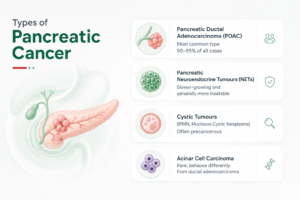
The most common types of pancreatic cancer include:
Why Pancreatic Cancer Is Complex
Pancreatic cancer is one of the most complex cancers to treat because the pancreas is located deep inside the abdomen, surrounded by major blood vessels and vital organs. Early tumours show no symptoms, which means many patients are diagnosed only after the disease has already spread.
Treatment is also highly specialised. Surgeries like the Whipple procedure involve multiple organs and require advanced HPB surgical expertise, experienced ICU care, and multidisciplinary cancer planning. In advanced cases of pancreatic cancer, chemotherapy, targeted therapy, and vascular reconstruction may also be required.
Reach Out for Expert Care
Symptoms of Pancreatic Cancer
Pancreatic cancer is often called a “silent” disease because its early stages rarely cause symptoms. By the time signs of pancreatic cancer appear, the disease may already be in an advanced stage. This is why high-risk individuals with chronic pancreatitis, diabetes onset after age 50, obesity, heavy smoking history, or a family history of pancreatic cancer should seek regular specialist review.
Common symptoms of pancreatic cancer, when they do appear:
- Persistent upper abdominal pain
- Unexplained weight loss
- Jaundice
- New-onset diabetes or sudden worsening of existing diabetes
- Dark urine and pale, oily stools
- Nausea, vomiting, and digestive discomfort
- Extreme fatigue and general weakness
Jaundice in particular, caused by tumours in the head of the pancreas blocking the bile duct, often brings patients to diagnosis at an earlier stage than those with body or tail tumours, which can remain silent much longer.
Detection of Pancreatic Cancer
Accurate diagnosis and precise staging are required before any pancreatic cancer treatment can be planned.
Investigations Include
- Contrast-enhanced CT scan (CECT Abdomen)
- MRI with MRCP
- Endoscopic Ultrasound (EUS)
- PET-CT scan
- Biopsy and Pathology
- Blood Tests
Staging of Pancreatic cancer
Pancreatic cancer is staged from Stage I (localised) to Stage IV (spread to distant organs). Critically, surgeons also classify tumours by resectability.
Here is a detailed overview:
| Resection Need | Meaning | Treatment Approach |
| Resectable | No vessel involvement | Surgery first |
| Borderline Resectable | Tumour touching but not encasing major vessels | Chemotherapy first, then surgery |
| Locally Advanced | Tumour encases major vessels | Chemotherapy ± radiation; surgery if good response |
| Metastatic | Tumour has spread to the liver, lungs, or other organs | Targeted therapy and supportive care |
Pancreatic Cancer Treatment Options in India
The right approach depends on the tumour location, resectability, the patient’s overall fitness for surgery, and the tumour’s molecular profile.
1. Whipple Surgery(Pancreaticoduodenectomy)
The Whipple procedure is the most commonly performed surgery for pancreatic cancer
What is removed during a Whipple procedure:
- Head of the pancreas
- Duodenum (first section of the small intestine)
- Gallbladder and lower bile duct
- Nearby lymph nodes
- Occasionally, part of the stomach
Click here to read more about cost and surgery for pancreatic cancer 👉 Whipple Surgery Cost in India | Pancreatic Surgery at Livcure
2. Robotic Pancreatic Surgery
For eligible patients, robotic-assisted pancreatic surgery using the da Vinci Xi system is available at Paras Health Gurugram.
What Robotic pancreatic surgery offers:
- Smaller incisions
- Reduced blood loss
- Shorter hospital stay
- Faster recovery
- Superior 3D visualisation when operating
Read more – Robotic Surgery Cost in India | Minimally Invasive Surgery
3. Distal Pancreatectomy
When cancer is located in the body or tail of the pancreas, a distal pancreatectomy is performed, typically removing the left portion of the gland, along with the spleen. This procedure is increasingly performed laparoscopically.
4. Total Pancreatectomy
When cancer involves the entire pancreas, complete removal of the gland is necessary. Patients require lifelong insulin therapy and pancreatic enzyme supplementation at every meal.
Stage 4 Pancreatic Cancer Treatment in India
Stage 4 pancreatic cancer means the disease has spread to distant organs, most commonly the liver. Surgery is usually not possible, but treatment can still help patients live longer and feel better.
Treatment may include:
- Advanced genetic testing (NGS) – Checks for BRCA and other mutations to guide targeted treatment before chemotherapy starts
- Chemotherapy – Standard treatments like FOLFIRINOX or gemcitabine + nab-paclitaxel
- Targeted therapy – Medicines such as olaparib or pembrolizumab
- Supportive care – Pain relief, nutrition support, and enzyme replacement to improve quality of life
Reach Out for Expert Care
Pancreatic Cancer Treatment Cost in India
Pancreatic cancer treatment in India is more affordable than in the US or UK, while maintaining high surgical standards at experienced HPB centres.
Here is the estimated average cost of pancreatic cancer treatment in India
- Whipple Surgery: ₹4-8 lakh
- Robotic Whipple Surgery: ₹7-9 lakh
- Distal Pancreatectomy: ₹3-9 lakh
- Total Pancreatectomy: ₹3.5-10 lakh
Additional costs may include:
- Scans & biopsy: ₹40,000-₹1 lakh
- Molecular profiling (NGS): ₹65,000-₹1.3 lakh
All treatment costs are shared in advance for complete transparency.
👉 Whipple Surgery Cost in India | Robotic Surgery Cost
👉 Request a personalised cost estimate →
Choosing an Experienced Pancreatic Cancer Surgeon in India
Pancreatic cancer does not give second chances easily. The surgeon you choose, the hospital you walk into, and the team reviewing your case before a single incision is made, these decisions shape everything that follows.
Under the guidance of Dr. Ankur Garg, pancreatic cancer is managed by a dedicated HPB programme built specifically for the complexity this disease demands.
- Dr. Ankur Garg brings 25+ years of subspecialty HPB experience and over 4,500 major surgeries to every case he takes on. He has operated on patients with borderline tumours, and his surgical volume places him among the highest-volume Whipple surgeons in India.
- For international patients travelling from outside India, a virtual consultation with Dr. Garg can be arranged before you book a flight. You arrive with a treatment plan already confirmed.
- The full surgical range is available- open Whipple, robotic pancreatectomy, laparoscopic distal pancreatectomy, total pancreatectomy, and vascular resection for borderline cases.
One centre. One specialist HPB team. India’s leading pancreatic cancer surgeons.
Get Expert Pancreatic Cancer Treatment in India
If you have received a diagnosis of pancreatic tumour, or are looking for an HPB expert opinion before finalising a treatment plan, the earlier you speak to an experienced HPB surgeon, the more options remain open to you.
A consultation with Dr Ankur Garg starts with a complete understanding of your case, your scans, your pathology, your stage, and your fitness before any recommendation is made. There is no pressure, no rushed decision, and no standard protocol applied to situations that deserve individual attention.
Call us. WhatsApp us. Fill the form below. Our team responds within 24 hours and can arrange a virtual consultation with Dr. Garg for international patients before you travel.
Frequently Asked Questions
What causes pancreatic cancer? expand_more
Risk factors of pancreatic cancer may include smoking, chronic pancreatitis, obesity, long-standing diabetes, increasing age, family history of pancreatic cancer, and certain genetic mutations.
What are the first warning signs of pancreatic cancer? expand_more
The warning signs commonly include jaundice, unexplained weight loss, upper abdominal pain, back pain, loss of appetite, and new-onset diabetes.
Can pancreatic cancer be cured if caught early? expand_more
Yes. If pancreatic cancer is diagnosed at an early stage, the tumour can be completely removed with surgery.
Is pancreatic cancer surgery safe? expand_more
Pancreatic cancer surgery is a complex procedure, but experienced HPB surgeons and dedicated hpb hospitals help reduce complications through careful planning and modern surgical techniques.

Dr. Ankur Garg's Medical Content Team
Dr. Ankur Garg’s medical content team specialises in creating accurate, clear, and patient-focused healthcare content. With strong clinical understanding and expertise in technical writing and SEO, the team translates complex medical information into reliable, accessible resources that support informed decisions and uphold Dr. Ankur Garg’s commitment to quality care.

 WhatsApp