
Is Liver Transplant in India Safe? What Patients Need to Know

When a doctor first mentions liver transplant, most patients have one urgent question: Is it actually safe? This is the right question to ask. This article provides a clear, medically grounded answer based on current evidence, regulatory standards in India, and what you need to know before choosing a transplant centre.
India has emerged as one of the most active liver transplant destinations in the world. Hospitals across Delhi NCR, Mumbai, Chennai, and Bengaluru now perform hundreds of transplants annually, with outcomes that are comparable to leading international programmes. In Delhi NCR alone, which covers Gurugram, Noida, and Faridabad, several high-volume programmes operate. Yet patients both from within India and from abroad often arrive with genuine confusion about standards, risks, and safeguards.
This guide is written to address the most common patient questions directly.
How India Regulates Liver Transplantation
A critical starting point for understanding safety is the regulatory framework. Liver transplantation in India is not unregulated. It is governed by the Transplantation of Human Organs and Tissues Act (THOTA), 1994, which was amended in 2011 and 2014 and implemented through rules notified in 2014. This legislation is administered at the state level with national coordination through NOTTO (National Organ and Tissue Transplant Organisation), under the Ministry of Health and Family Welfare.
Under THOTA, every transplant centre must be formally registered and inspected. Deceased donor transplants are coordinated through state-level organisations called STTOs (State Transplant Task Organisations), which maintain waiting lists and allocate organs through a defined protocol.
The law prohibits commercial trade in organs and lays out strict criteria for living donor eligibility, including near-relative donation provisions and approval by independent authorisation committees.
Liver Transplant Survival Rates in India: What the Data Shows
When worrying about safety, survival rates are the most objective measure available. The liver transplant survival rate in India at experienced centres, including 1-year, 3-year, and 5-year benchmarks, has now converged with those reported by leading programmes in the United States, Europe, and Southeast Asia.
| Time After Transplant | India | Global Benchmark |
| 30-Day Survival | 92–95% | 92–96% |
| 1-Year Survival | 85–90% | 87–91% |
| 3-Year Survival | 80–85% | 80–86% |
| 5-Year Survival | 75–82% | 74–82% |
Note: These figures apply specifically to high-volume, experienced centres. Outcomes vary significantly between programmes with different transplant volumes, surgical team experience, and intensive care infrastructure.
This is why choosing the right centre, not simply “a centre in India”, is the single most important safety decision patients make.
Types of Liver Transplant and Their Safety Profiles
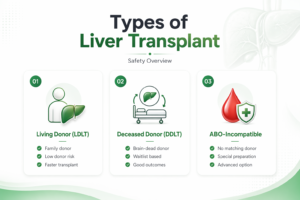
Understanding what kind of transplant is being recommended is essential for understanding the associated risks.
Living Donor Liver Transplant (LDLT)
- In a living donor liver transplant, a portion of the liver (typically the right lobe) is surgically removed from a healthy donor, usually a near-relative, and transplanted into the recipient. The donor’s remaining liver regenerates to full functional volume within 6-8 weeks.
- India has one of the highest volumes of LDLT globally, partly because of a cultural acceptance of living donation and partly because deceased donor availability remains limited.
- Donor safety is the foremost ethical obligation in this type of surgery. The operative mortality risk for the donor is estimated at approximately 0.1-0.5% at experienced centres, and complication rates in well-selected donors are low.
Deceased Donor Liver Transplant (DDLT)
- In a deceased donor transplant, the liver is retrieved from a brain-dead individual following family consent.
- Deceased donor transplants carry similar recipient outcomes to living donor transplants in experienced hands, though donor organ quality and cold ischaemia time are important variables. Patients with advanced end-stage liver disease may be listed for a deceased donor organ based on their MELD score.
ABO-Incompatible Liver Transplant
- For patients who urgently need a transplant but have no compatible living donor, an ABO-incompatible liver transplant is a specialised option.
- This requires additional pre-operative preparation using plasmapheresis and immunosuppression protocols developed over the past decade.
- Outcomes at experienced centres in India are now approaching those of ABO-compatible transplants.
Real Risks of Liver Transplant in India
Transparency about risk is the foundation of ethical medical communication. A liver transplant is a major surgical intervention, and patients deserve to understand the specific risks involved, not to be discouraged, but to make informed decisions and set realistic expectations.
Important Note for Patients: The risks below are general information and do not apply uniformly to all patients. Your transplant surgeon is the appropriate person to discuss your individual risk profile.
Bleeding
- Bleeding is the most common surgical concern, particularly in patients with advanced liver cirrhosis who may already have coagulation abnormalities and portal hypertension.
Rejection
- The immune system may recognise the transplanted liver as foreign and mount a rejection response.
Medication Side Effects
- Long-term calcineurin inhibitors (such as tacrolimus) can affect kidney function, blood pressure, and blood sugar levels. Regular monitoring allows early detection and dose adjustment.
- Patients should not be alarmed by the need for lifelong medication. This is a predictable and manageable aspect of post-transplant care, not a complication.
How to Choose a Safe Liver Transplant Centre in India
Safety depends more on the centre and team than the procedure itself. Focus on these key factors to choose the best hospital for liver transplant in India:
- High transplant volume: More experience usually means better outcomes
- Multidisciplinary team: Hepatologist, surgeon, ICU, infection specialist
- Dedicated ICU & infection control: Critical for early recovery
- Donor safety protocols: Essential for living donor transplants
- Structured follow-up: Regular monitoring and easy access to care
- Clear cost transparency: Avoid vague estimates or unrealistic promises
Patients should choose a centre based on experience, outcomes, and systems of care, not just cost or location.
Life After Liver Transplant in India
Life after liver transplant in India is, for most patients, a genuinely healthy and productive life, not a permanently medicalised existence. Long-term commitments include daily immunosuppressive medication, regular blood monitoring, complete alcohol abstinence where relevant, and annual surveillance for new malignancies. These are manageable responsibilities; they are the terms under which a healthy new life becomes possible.
Common Myths About Liver Transplant in India
Patients and families often come across conflicting or misleading information online. Clearing these myths is essential to making informed, confident decisions.
Myth 1: Liver transplant in India is not safe
Reality: Liver transplant in India is performed under strict legal and medical regulation. High-volume centres report survival rates comparable to global benchmarks. Safety depends more on centre experience and team expertise than on geography.
Myth 2: A donor cannot live a normal life after donation
Reality: In a living donor liver transplant (LDLT), the liver regenerates. Most donors return to normal daily activities within a few weeks, and long-term health is typically unaffected when proper screening and follow-up are done.
Myth 3: Liver transplant is always the last and hopeless option
Reality: A transplant is recommended when it offers the best chance of survival and quality of life. Many patients undergo transplant at the right stage and go on to live long, productive lives.
Myth 4: Survival rates are low after a liver transplant
Reality: The liver transplant success rate in India is high at experienced centres, with around 85–90% survival at 1 year. Long-term survival continues to improve with better surgical techniques and post-transplant care.
Myth 5: You will be bedridden or dependent for life
Reality: Most patients regain independence within a few months. With proper medication and follow-up, many return to work, travel, and normal routines.
Myth 6: Liver transplant is too risky because of rejection
Reality: Rejection is a known risk, but it is usually manageable with modern immunosuppressive medications. Regular monitoring helps detect and treat rejection early.
Myth 7: Liver transplant in India is only for Indian patients
Reality: India is a major destination for international patients seeking liver transplants due to a combination of experienced teams, regulated systems, and cost-effective care.
Takeaway:
When evaluating whether a liver transplant is safe in India, the most important factors are the experience of the transplant centre, transparency of outcomes, and quality of post-operative care. Myths can create unnecessary fear; accurate information helps patients make the right decision at the right time.
Final Thoughts: Is Liver Transplant in India Safe?
A liver transplant in India is safe when performed at a licensed centre by an experienced team. The important factors to consider are:
- Surgeon experience
- ICU and infection control systems
- Survival outcomes
- Strict donor evaluation and ethical compliance
- Long-term follow-up care
The liver transplant procedure itself carries some real risks, but these are highly manageable in the right setting. For most patients, a transplant offers not just extended survival, but a meaningful return to normal life.
Bottom line:
The real question is not just “Is liver transplant safe in India?”– it is “Is the centre you choose equipped to deliver it safely?”

 WhatsApp