
LFT Test Explained in Simple Language for Patients
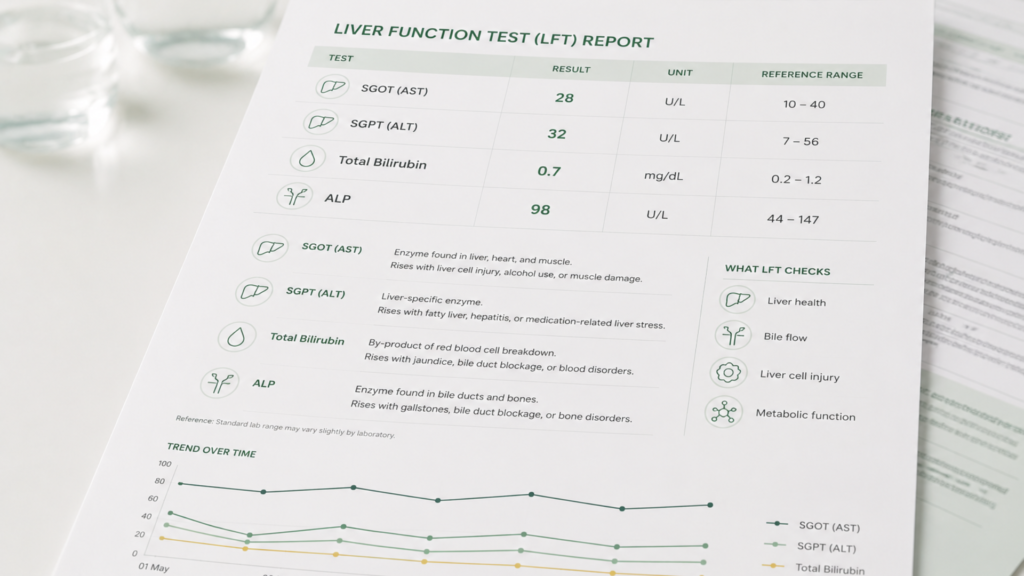
SGPT High in Your Report? Here’s What Your LFT Results Actually Mean
Your doctor ordered a Liver Function Test.
The report came back, and now you’re staring at a page full of abbreviations.
SGOT. SGPT. Bilirubin. ALP.
Numbers you don’t recognise. Ranges you can’t make sense of.
Families often ask:
- “Doctor, SGPT itni zyada kyu hai?”
- “Kya liver damage ho gaya hai?”
- “Yeh bilirubin ka matlab kya hota hai?”
- “Normal range kya honi chahiye?”
This article explains, in simple language, exactly what each marker means, what’s normal, and when to be concerned.
What Is a Liver Function Test (LFT)?
The liver is one of the hardest-working organs in your body.
It filters toxins from your blood. It produces proteins. It helps digest food. It regulates hundreds of chemical processes.
When liver cells are under stress or getting damaged, they release certain chemicals into the bloodstream.
An LFT test measures those chemicals.
It doesn’t just detect liver disease; it helps doctors understand what kind of problem is happening and how serious it is.
Request a Consultation
1. SGOT (AST) – The First Alarm
SGOT full form: Serum Glutamic Oxaloacetic Transaminase
Also called: AST (Aspartate Aminotransferase)
SGOT Normal range: 10-40 U/L
SGOT is found not only in the liver; it’s also present in the heart, muscles, and kidneys.
This means that when SGOT is high, it doesn’t always directly indicate liver disease. The problem could be elsewhere.
SGOT rises when there is:
- Liver inflammation
- Fatty liver disease
- Alcohol-related liver damage
- Heart muscle injury
- Intense physical exercise
- Certain medications
Think of SGOT as a general distress signal.
It tells you something is wrong, but not exactly where.
2. SGPT (ALT) – The Liver-Specific Marker
SGPT full form: Serum Glutamic Pyruvic Transaminase
Also called: ALT (Alanine Aminotransferase)
Normal range: 7-56 U/L
SGPT is almost exclusively produced by the liver, and this makes it far more specific.
When SGPT is elevated, doctors know the liver is the source. It is the single most reliable early indicator of liver cell damage.
SGPT rises when there is:
- Non-alcoholic fatty liver disease (NAFLD)
- Viral hepatitis – A, B, or C
- Alcoholic liver disease
- Paracetamol overuse or medication toxicity
- Autoimmune hepatitis
The SGOT: SGPT ratio matters
If SGOT is more than twice the value of SGPT, it often suggests alcohol-related liver damage.
If SGPT is higher than SGOT, it more commonly points to fatty liver or viral hepatitis.
Doctors look at both together.
3. Bilirubin – The Yellowing Signal
Normal range: Total Bilirubin: 0.2-1.2 mg/dL, Direct Bilirubin: 0-0.3 mg/dL, Indirect Bilirubin: 0.2-0.9 mg/dL
Every day, the body breaks down old red blood cells; this process produces a yellow pigment called bilirubin.
The liver processes this bilirubin and removes it through bile.
When the liver cannot keep up or when a bile duct is blocked, bilirubin accumulates in the blood.
The result: Jaundice, skin turns yellow, eyes turn yellow.
Your report shows three bilirubin values:
- Direct bilirubin is processed bilirubin that the liver has already worked on. High direct bilirubin points to a blockage in the bile ducts.
- Indirect bilirubin is unprocessed bilirubin. High indirect bilirubin points to rapid red blood cell breakdown.
- Total bilirubin is the sum of both.
Elevated bilirubin can mean:
- Jaundice
- Gallstones blocking the bile duct
- Liver disease or failure
- Blood disorders (hemolysis)
- Newborn jaundice is often normal and temporary
4. ALP – The Bile Duct Indicator
Full name: Alkaline Phosphatase
Normal range (adults): 44-147 U/L.
ALP is an enzyme that lines the bile ducts.
When there is a blockage due to gallstones, inflammation, or a tumour, ALP rises.
ALP rises when there is:
- Bile duct blockage (cholestasis)
- Gallstones
- Primary biliary cholangitis
- Liver tumors pressing on the bile ducts
- Bone disorders
Important note: ALP is naturally higher in children (growing bones), pregnant women, and older adults. Always check your lab’s age-specific reference range before drawing conclusions.
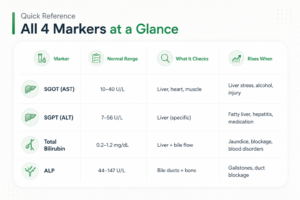
Quick Reference: All 4 Markers at a Glance
What Families Often Get Wrong
“SGPT thoda zyada hai, kya liver kharab ho gaya?”
Not necessarily.
A mildly elevated result under two times the upper limit can be caused by a recent heavy meal, a painkiller taken the night before, or even intense exercise.
Doctors usually retest after 4-6 weeks and look for trends, not a single number.
“Ek number high hai toh kya treatment shuru kar de?”
An LFT is not read number by number.
It is read as a pattern combined with symptoms, physical examination, and sometimes an ultrasound or further blood tests.
One abnormal value rarely tells the full story.
When to Take an Abnormal LFT Seriously
A single mildly raised result with no symptoms may just need a repeat test.
But pay attention if:
- SGPT is more than 3 times the upper limit of normal
- Bilirubin is rising alongside SGOT and SGPT
- ALP is significantly elevated along with bilirubin
- You have symptoms like fatigue, abdominal discomfort, yellowing of the eyes, dark urine, and swelling in the abdomen
These combinations suggest something more than a temporary fluctuation.
Final Word
An LFT report is not a verdict.
It is a signal.
It tells your doctor and you that something may need attention, and how urgently.
Understanding what SGOT, SGPT, Bilirubin, and ALP mean puts you in a better position to ask the right questions, follow up appropriately, and not panic over numbers that need context.
If your report shows consistent abnormalities, have it reviewed by a specialist who can consider the full picture.
Have questions about your LFT report? Consult the LivCure team — Book an Appointment

 WhatsApp