
Best Liver Cancer (HCC) Treatment in India – Dr. Ankur Garg
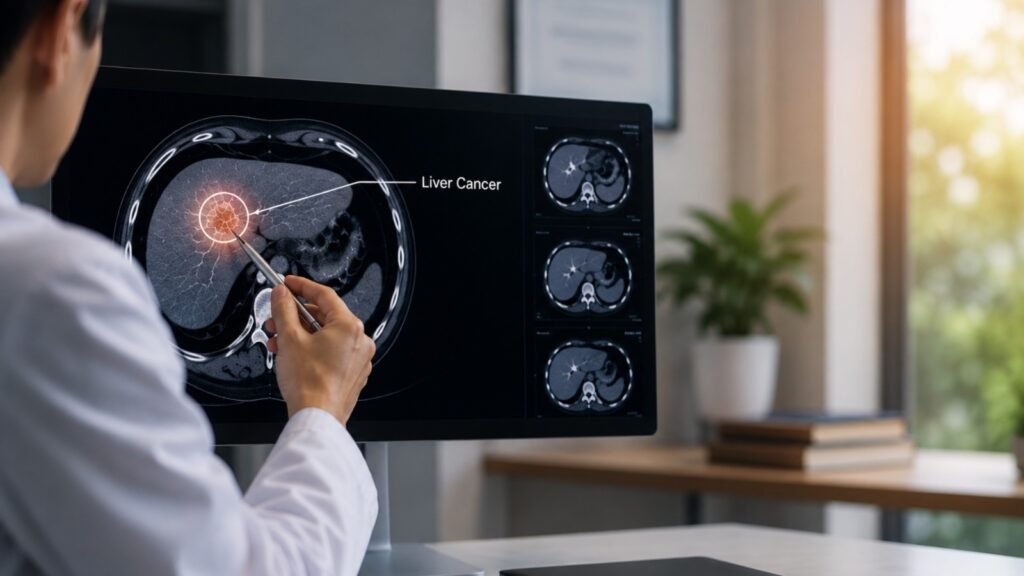
Liver cancer is the tenth most common cancer in India, with 34,743 new cases and 33,793 deaths recorded annually. Nearly 80% of those are hepatocellular carcinoma (HCC). It’s a disease that is growing, driven by rising rates of fatty liver disease, diabetes, and hepatitis infections.
What makes HCC hepatocellular carcinoma treatment genuinely complex is that the tumour almost always develops inside a liver that is already diseased by cirrhosis. hepatitis B or C. Fatty liver. That complexity is exactly why HCC demands a dedicated HPB specialist.
With 25+ years of dedicated HPB experience and over 4,500 major liver surgeries, Dr. Ankur Garg at Paras Health Gurugram is among India’s most experienced specialists for liver cancer (HCC) treatment.
This guide covers every liver treatment option: resection, transplant, TACE, TARE, and ablation, and helps you understand which approach fits your diagnosis
What Is Hepatocellular Carcinoma?
Hepatocellular carcinoma is a cancer that starts in the hepatocytes (the liver’s primary working cells). It is a primary liver cancer, meaning it originates in the liver itself.
It usually occurs in patients with chronic liver disease, such as:
- cirrhosis
- hepatitis B or C
- fatty liver disease (NAFLD/NASH)
Cancer that has spread to the liver from the colon, breast, or lungs (metastatic liver cancer) is managed differently from HCC.
Common types of primary liver cancer:
- Hepatocellular carcinoma (HCC)
- Fibrolamellar hepatocellular carcinoma – a rare subtype that typically affects younger patients without underlying cirrhosis
- Cholangiocarcinoma – arises from bile duct cells; managed differently from HCC.
- Mixed hepatocholangiocarcinoma – combines features of both; more aggressive.
Accurate identification of liver cancer type determines whether surgery, transplant, TACE, or systemic therapy is required.
Request a Consultation
Who Gets HCC? Risk Factors in India
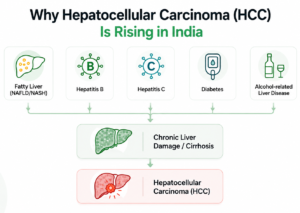
The most frequent risk factors for HCC in India include non-alcoholic fatty liver disease, hepatitis B virus and hepatitis C virus infection, liver cirrhosis, and alcohol intake. The pattern is also shifting historically; hepatitis-driven disease, HCC in urban India, is increasingly linked to lifestyle-related liver damage.
Key risk factors:
- Liver cirrhosis
- Chronic Hepatitis B
- Chronic Hepatitis C
- NAFLD/NASH
- Alcohol-related liver disease
- Aflatoxin exposure
- Diabetes mellitus
If you have cirrhosis or chronic hepatitis B, a liver ultrasound every six months with AFP monitoring is recommended. This is how HCC is caught when the cure is still possible.
Symptoms of HCC
The liver has no pain receptors. A tumor can grow large in size without causing any noticeable discomfort. By the time symptoms appear, the disease is often advanced.
Symptoms that bring most patients to diagnosis:
- Heaviness under the right rib cage
- Unexplained weight loss
- Fatigue that does not resolve with rest
- Jaundice
- Abdominal swelling from fluid accumulation (ascites)
- Sudden worsening of existing liver disease in a known cirrhotic patient
That last point matters most. Any new symptom in a patient with chronic liver disease is a red flag until proven otherwise. Do not wait for it to pass.
Hepatocellular Carcinoma Diagnosis and Treatment
Accurate diagnosis and treatment planning for hepatocellular carcinoma start with the right investigations.
Imaging
- Contrast-enhanced CT (CECT abdomen)
- MRI liver with contrast
- Ultrasound
Blood Tests
- AFP (Alpha-fetoprotein)
- Liver function tests
- Child-Pugh and MELD scores
Hepatocellular Carcinoma Treatment Options in India
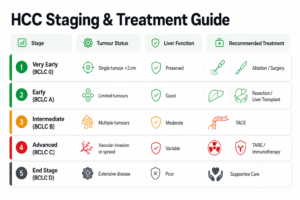
The right hepatocellular carcinoma treatment options depend on stage, liver function, fitness for surgery, and tumour biology.
1. Liver Resection – Surgical Removal for Early-Stage HCC
Surgical resection of the liver offers the strongest chance of a lasting cure. The liver’s ability to regenerate makes resections possible.
Resection types depending on tumour location:
- Segmentectomy – one or more liver segments removed
- Lobectomy – an entire lobe removed
- Extended hepatectomy – more than three segments, for larger tumours
Dr. Garg performs both laparoscopic liver resection and robotic liver surgery for eligible patients.
👉 Liver Resection Surgery at Livcure 👉 Minimally Invasive Surgery at Livcure
2. Liver Transplant – The Most Complete Solution for Eligible Patients
Liver transplantation is the only treatment that removes both the tumour and the diseased liver.
Dr. Garg performs both living donor liver transplant (LDLT), where a family member donates a portion of their liver, and ABO-incompatible liver transplant, expanding the donor pool for patients who cannot wait for a deceased donor organ.
👉 Liver Transplant at Livcure 👉 ABO-Incompatible Liver Transplant
3. Ablation Therapy – Destroying Tumours Without Surgery
Ablation uses heat energy to destroy HCC tumours in place, without removing them surgically.
Radiofrequency Ablation (RFA) – uses heat generated by radiofrequency waves; effective for tumours up to 3 cm.
- Microwave Ablation (MWA) – faster and more effective for slightly larger tumours.
4. Hepatocellular Carcinoma TACE Treatment – For Intermediate and Multifocal HCC
TACE is the standard of care for intermediate-stage HCC when surgery or ablation is not feasible, and liver function remains preserved.
5. TARE Treatment (Transarterial Radioembolization)
TARE is an advanced, minimally invasive treatment for liver cancer. In this procedure, very small radioactive particles are delivered directly into the blood vessels. These particles release radiation inside the tumour to destroy cancer cells while causing minimal damage to the healthy part of the liver.
Hepatocellular Carcinoma Treatment and Prognosis – Honest Numbers
The rising incidence of HCC in India is concerning, with major contributing factors being chronic hepatitis B and C infections, alcohol consumption, and metabolic-associated liver disease.
The overall 5-year survival for HCC in India is around 15 – 20% because over 60-70% of cases are diagnosed at advanced stages. At high-volume HPB centres outcomes are meaningfully better:
| Treatment | Prognosis |
| Liver resection | 5-year survival 50 – 70% |
| Liver transplant | 5-year survival >70% |
| Ablation | 5-year survival 40 – 60% |
| TACE | 3-year survival 15 – 30% |
| Advanced HCC – systemic therapy | Median overall survival 16 -19 months |
Why Patients Trust Dr. Ankur Garg for Hepatocellular Carcinoma Treatment in India
HCC is not a condition for a generalist. Treating cancer inside a diseased liver while preserving enough function to keep the patient well requires someone who has done this hundreds of times.
Dr. Garg brings 25+ years of dedicated HPB and liver transplant experience to every case. He has managed HCC patients at every stage, from small, resectable tumours to complex, multifocal disease.
For international patients, a virtual consultation with Dr. Garg is arranged before travel. Written cost estimates are confirmed before any commitment is made. Medical visa documentation, accommodation coordination, and post-discharge telemedicine follow-up are all managed by the Livcure team.
Key Takeaways
- HCC is India’s most common primary liver cancer, and most cases are caught too late simply because patients did not know they were at risk.
- If you have cirrhosis or chronic hepatitis B, a liver ultrasound every six months is not a suggestion it is how HCC is caught when cure is still possible
- Surgery is the only curative option, and it is only available while the tumor is still confined and the liver can tolerate it
- Liver transplant removes both the cancer and the diseased liver
- TACE, TARE, and ablation are not last resorts; they control disease.
- The decisions made in the first weeks after diagnosis shape everything, which is why the specialist you see first matters more than most patients realise.

 WhatsApp