Liver Cancer Treatment in India
Liver cancer is the third leading cause of cancer death worldwide, with over 830,000 deaths recorded globally in 2020. In India, the numbers are rising. North India now has the fastest-growing rate of liver cancer cases in the country, with hepatitis infections, alcohol-related liver disease, and fatty liver disease all playing a role.
When a family gets this diagnosis, the first question is always the same: “What can we do?”
The answer depends on the type of liver cancer, the stage, and how well the liver is still working. Liver cancer treatment in India has advanced considerably, and patients today have access to surgical and non-surgical options that match international standards. Getting the right evaluation from the right team early makes all the difference.
At LivCure India, Dr. Ankur Garg leads a multidisciplinary liver cancer program at Paras Health, Gurgaon. With over 25 years of experience and more than 4,500 liver transplants and hepatobiliary procedures, the team evaluates each patient individually and builds a treatment plan based on evidence rather than assumptions.
👉 Get a personalised liver cancer treatment plan
📞 +91 87002 71068
What Is Liver Cancer?
Liver cancer is cancer that starts in the liver itself. The most common type is hepatocellular carcinoma (HCC), which grows from the liver’s own cells (hepatocytes). It accounts for roughly 90% of all primary liver cancers globally. Most HCC cases develop in livers already damaged by cirrhosis, hepatitis B, or hepatitis C.
There are several types of primary liver cancer:
- Hepatocellular Carcinoma (HCC): By far the most common. It develops directly in liver cells and is strongly linked to chronic liver disease. This is the type that most patients at liver cancer centres in India will have.
- Intrahepatic Cholangiocarcinoma (bile duct cancer): Starts in the bile ducts inside the liver. It accounts for around 10-20% of primary liver cancers.
- Angiosarcoma: A rare type that starts in the blood vessels of the liver. It tends to grow fast and is more common in older adults.
- Hepatoblastoma: Very rare. Mostly affects young children, usually under age 2.
- Secondary (metastatic) liver cancer: Cancer that started somewhere else in the body and spread to the liver. It is not the same as primary liver cancer, and the treatment is different. Colorectal, breast, and lung cancers are common sources.
Most patients in India and at LivCure have HCC. The rest of this page focuses on HCC, though the diagnostic and treatment frameworks apply broadly.
What Are the Risk Factors for Liver Cancer?
Liver cancer doesn’t appear randomly. In most cases, it develops over years of ongoing liver injury. The main risk factors for HCC are chronic hepatitis B infection, chronic hepatitis C infection, liver cirrhosis from any cause, heavy alcohol use, and non-alcoholic fatty liver disease (NAFLD/MASLD). In India, hepatitis B is the most common cause, and people with HBV infection carry up to a 100-fold higher risk of developing HCC.
- Hepatitis B (HBV): Research from India identifies HBV as the dominant cause of liver cancer in the country. Many patients are HBeAg-negative or have low viral loads, yet still carry real risk.
- Hepatitis C (HCV): HCV leads to cirrhosis more readily than HBV, and people with HCV-related cirrhosis face a particularly high risk of HCC.
- Liver Cirrhosis: Nearly 70-90% of all HCC cases occur in livers with cirrhosis. Cirrhosis from any cause raises the risk. For patients already managing liver cirrhosis, surveillance for HCC is not optional.
- Alcohol-related liver disease: Heavy, prolonged alcohol use leads to cirrhosis. People who drink heavily and also have viral hepatitis face a compounded risk.
- NAFLD/MASLD: This is now the fastest-growing cause of HCC in India. Updated 2024 epidemiological data shows alcohol and MASLD have overtaken viral hepatitis as leading causes of HCC in many parts of the country, tied to rising obesity and diabetes rates.
- Aflatoxin exposure: A toxin produced by certain moulds that can contaminate stored grains and groundnuts. Relevant in parts of India with poor grain storage conditions.
- Diabetes: Indians develop type 2 diabetes at younger ages than Western populations, and diabetes raises HCC risk independently of other liver conditions.
If you have one or more of these risk factors, six-monthly surveillance with an ultrasound and AFP blood test is the standard recommendation.
Reach Out for Expert Care
Symptoms of Liver Cancer: What to Watch For
This is the part that families find most frustrating: liver cancer often produces no symptoms until it is already at an advanced stage.
The liver has a significant reserve capacity. A tumour can grow inside it for months without causing pain, jaundice, or any noticeable change. By the time most patients develop clear symptoms and seek care, the disease is already in an intermediate or advanced stage. This is exactly why regular surveillance for high-risk patients matters so much.
When symptoms do appear, they typically include:
- Persistent pain or discomfort in the upper right side of the abdomen
- Unexplained weight loss over a short period
- Loss of appetite that doesn’t improve
- Swelling or bloating in the abdomen (ascites)
- Jaundice (yellowing of skin or eyes)
- Extreme fatigue
- A noticeable lump in the right upper abdomen
In patients who already have cirrhosis, a sudden worsening of liver function, new ascites, or unexplained pain should prompt immediate evaluation for HCC. Don’t wait for several symptoms to appear together before consulting a specialist.
How Is Liver Cancer Diagnosed? Tests and Medical Evaluation
Diagnosing liver cancer starts with imaging. For high-risk patients, an ultrasound every 6 months, combined with an AFP blood test, is standard. When a suspicious lesion is found, the evaluation moves to more detailed scans.
- AFP Blood Test (Alpha-fetoprotein): AFP is a tumour marker that rises in many people with HCC. However, many early-stage HCC patients have normal AFP levels, so a normal result doesn’t rule out cancer. AFP is most useful when paired with imaging, and for monitoring treatment response once cancer is confirmed.
- Liver Ultrasound: The first-line imaging test. It’s affordable, non-invasive, and widely available. It detects suspicious lesions that require further investigation. Combining ultrasound with AFP improves early detection by over 60% compared to either test used alone.
- CT Scan (Triphasic): A CT scan with contrast dye, taken in three timed phases, provides detailed images of blood flow through liver tumours. HCC has a characteristic triphasic CT pattern (arterial enhancement, then washout) that can confirm the diagnosis without biopsy in the right clinical context.
- MRI Liver: Similar diagnostic accuracy to CT for most HCC cases. MRI is preferred when there are concerns about radiation or contrast allergy, and it’s better at characterising fatty changes that might obscure CT findings.
- Liver Biopsy: Not always necessary. If imaging and AFP clearly indicate HCC, a biopsy adds little and carries a small procedural risk. It’s used when imaging is inconclusive, when unusual tumour subtypes are suspected, or when gene-level tumour analysis is needed to guide targeted therapy.
- Liver Function Tests and Staging Scores: Understanding how well the liver is still working is just as important as characterising the tumour. The Child-Pugh and MELD scores both assess residual liver function and directly influence which treatment options are viable.
- BCLC Staging: The Barcelona Clinic Liver Cancer (BCLC) system is the most widely used framework for staging HCC and guiding treatment. It considers tumour size and number, vascular invasion, spread beyond the liver, performance status, and liver function, and classifies patients from Stage 0 (very early) to Stage D (end-stage), with a matched treatment pathway at each level.
Is Liver Cancer Curable?
Whether liver cancer can be cured depends mainly on the stage at diagnosis and how well the liver is functioning.
Early-stage liver cancer, especially hepatocellular carcinoma (HCC), can often be treated with curative intent using liver resection or liver transplant. In selected patients, transplant offers long-term survival with 5-year survival rates of 60–70%.
However, advanced liver cancer is usually not fully curable. In these cases, treatment focuses on controlling the disease, improving survival, and maintaining quality of life through therapies such as TACE, TARE, targeted therapy, and immunotherapy.
Liver Cancer Treatment Options in India
The right approach to liver cancer treatment depends on the disease stage, how many tumours are present, whether the liver is functioning adequately, and the patient’s overall health. India now offers the complete range of curative and palliative treatment options, including advanced interventional procedures and current immunotherapy protocols.
Surgical Options
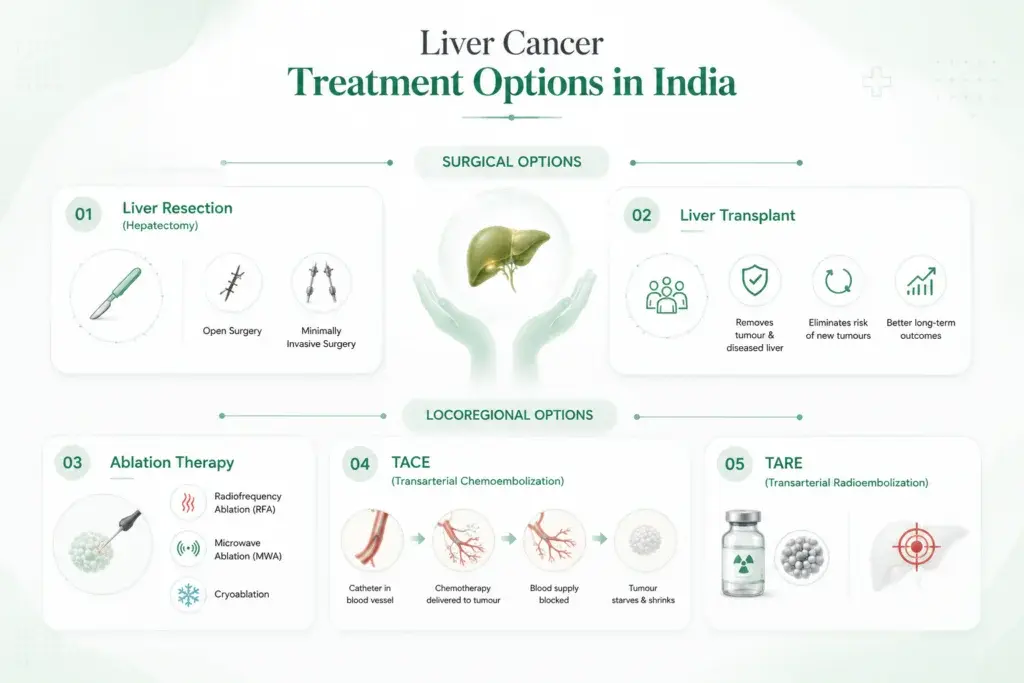
Liver Resection (Hepatectomy): For patients with a single tumour and good liver function, surgical removal of the affected part of the liver is the primary curative option. Only 30-40% of HCC patients qualify for surgery at diagnosis, typically because most present with advanced disease or significant underlying cirrhosis. Dr. Ankur Garg’s team at LivCure performs liver resection surgery using both open and minimally invasive approaches, tailored to the extent of resection needed.
Liver Transplant: For patients within the Milan Criteria (a single tumour up to 5 cm, or up to three tumours with none exceeding 3 cm, and no vascular invasion), liver transplant removes both the tumour and the diseased liver. This eliminates the risk of new tumours developing in damaged tissue. The 5-year survival rate after liver transplant for eligible patients is 60-70%. LivCure’s liver transplant programme at Paras Health has one of the highest-volume teams in North India.
Locoregional Options
Ablation Therapy: For patients who can’t have surgery because of poor liver function or other health problems, ablation destroys tumours directly. Radiofrequency Ablation (RFA) uses heat from radio waves. Microwave Ablation (MWA) works similarly but is faster and more effective for larger tumours. Cryoablation uses extreme cold to freeze tumour tissue. These are most effective for tumours under 3 cm. LivCure offers ablation therapy as part of its HCC treatment pathway.
TACE (Transarterial Chemoembolization): The standard treatment for intermediate-stage HCC (BCLC-B). TACE delivers chemotherapy directly into the tumour’s blood supply while blocking that supply, targeting the tumour from the inside while cutting off its nutrition. It’s also used as bridge therapy to keep tumours stable while a patient waits for a transplant. Success rates for TACE in early-to-intermediate disease range from 60-80%.
TARE (Transarterial Radioembolization): Similar to TACE but uses tiny radioactive microspheres (Y-90) instead of chemotherapy. TARE is gaining traction in India as an option for patients who aren’t ideal candidates for TACE.
Reach Out for Expert Care
Side Effects of Liver Cancer Treatment
Side effects vary depending on the treatment used.
- Surgery: pain, fatigue, risk of infection
- TACE/TARE: fever, abdominal discomfort, nausea
- Targeted therapy: fatigue, high blood pressure, skin reactions
- Immunotherapy: immune-related inflammation in organs
Most side effects are manageable when monitored closely by a specialist team.
Liver Cancer Prognosis: What Affects Survival?
Prognosis in liver cancer depends primarily on the stage at diagnosis. Early-stage liver cancer is treatable, and outcomes have improved over the last decade with better surgical techniques and newer systemic therapies. Advanced-stage disease is harder to manage, though current immunotherapy protocols have extended survival for many patients who previously had few options.
5-year survival rates by stage:
- Localised (confined to the liver): approximately 36%
- Regional (spread to nearby lymph nodes or structures): approximately 12%
- Distant (spread to other organs): approximately 3%
- Overall (all stages combined): approximately 22%
For patients who receive a liver transplant within the Milan Criteria, the 5-year survival rate is 60-70%.
Key factors that affect prognosis:
- Stage at diagnosis (earlier is much better)
- Whether liver function is preserved (Child-Pugh A vs B vs C)
- Whether the patient qualifies for curative treatment (resection or transplant)
- Response to locoregional or systemic therapy
- Whether there is vascular invasion or spread beyond the liver
For detailed information on liver cancer treatment cost in India, LivCure provides transparent guidance on what each treatment stage involves financially.
Why Choose India for Liver Cancer Treatment?
India has become a practical destination for liver cancer care, both for domestic patients and for international patients from Africa, the Middle East, and Southeast Asia. The reasons are clinical and financial.
Cost: Liver cancer surgery in India costs 80-90% less than equivalent procedures in the USA. A liver transplant in the USA can exceed $500,000. At a top-tier centre in India, the same procedure costs between $25,000 and $40,000. Even after accounting for travel and accommodation, international patients typically save over 60% in total treatment costs.
Technology: India’s leading liver centres use the same equipment as hospitals in the USA and Europe: robotic surgical systems, TACE and TARE suites, advanced MRI, and access to current immunotherapy protocols. The Indian liver cancer therapeutics market was valued at $54 million in 2024 and is projected to reach $90.55 million by 2030, at a CAGR of 9.17%, a direct reflection of investment going into the field.
Surgical volume: High volume matters in liver cancer. Surgeons who perform more hepatectomies and transplants have measurably better outcomes in the literature. Dr. Ankur Garg has performed over 4,500 liver transplants and HPB procedures over 25 years of clinical practice.
Access: There are no multi-year waiting lists. Patients can get an expert evaluation, a treatment plan, and start care within days of arriving at LivCure’s centres at Paras Health.
Conclusion
Liver cancer is a serious diagnosis. It is also not one that automatically closes all treatment options. The stage at which it’s found and the team managing it are the two things that matter most.
A few things worth remembering: if you have risk factors including hepatitis B or C, cirrhosis, alcohol-related liver disease, or fatty liver disease, regular six-monthly surveillance is the single most important step you can take. Early-stage liver cancer can be treated curatively. Late-stage liver cancer is much harder.
Liver cancer also requires team-based care a hepatobiliary surgeon, a transplant surgeon, a hepatologist, and an interventional radiologist, all reviewing the same case and agreeing on a plan.
India offers that level of care at costs accessible to domestic and international patients alike.
If you or a family member has been diagnosed with liver cancer, or if you’re managing a condition that puts you at risk, get a specialist evaluation.
Book a consultation with Dr. Ankur Garg and the LivCure team at Paras Health, Gurgaon.
Call us: +91 87002 71068
Dr. Ankur Garg's Medical Content Team
Dr. Ankur Garg’s medical content team specialises in creating accurate, clear, and patient-focused healthcare content. With strong clinical understanding and expertise in technical writing and SEO, the team translates complex medical information into reliable, accessible resources that support informed decisions and uphold Dr. Ankur Garg’s commitment to quality care.